We repair garbage disposals across Costa Mesa and Orange County, and disposal calls tend to be quick ones. Before booking a technician, there are a few things worth trying yourself, this guide walks through all of them, and explains when a problem genuinely needs professional attention.
The Disposal Hums But Won't Spin
This is the most common disposal problem, and it's usually a jammed grinding plate. The motor is running, that's the hum, but something is wedged between the plate and the grinding ring, stopping it from turning.
Here's how to clear it:
- Turn the disposal switch off and unplug the unit (or trip its breaker)
- Look under the sink, on the bottom of the disposal, there's a small hex socket (usually 1/4-inch)
- Insert an Allen wrench and turn it back and forth to manually free the jam
- Use tongs or pliers to remove the offending object from inside the disposal, never reach in with your hand
- Press the red reset button on the bottom of the unit, plug it back in, and run water before turning it on
The Disposal Won't Turn On At All
Silence when you hit the switch means the motor isn't getting power. Work through this checklist before calling anyone:
- Reset button: The disposal has a thermal overload that trips when the motor overheats. Press the small red button on the bottom of the unit, if it pops back in with a click, that was the problem. Run cold water and try the switch again.
- Circuit breaker: Disposals are usually on a dedicated circuit. Check your panel for a tripped breaker.
- Wall switch: If the reset and breaker are both fine, test whether the wall switch itself has failed using a multimeter or by swapping in a known-good switch.
- Motor failure: If none of the above resolves it, the motor has likely seized. At this point, replacement is almost always more practical than repair.
The Disposal Leaks
Where the leak comes from tells you exactly what's wrong:
- Leak from the top (where disposal meets sink): The sink flange seal has failed. This is fixed by removing the disposal, cleaning off the old plumber's putty, and resealing the flange. It's a moderately involved DIY job but straightforward with the right instructions.
- Leak from the side: Usually the dishwasher drain connection (the small rubber hose) or the discharge pipe gasket. Both are easy to tighten or replace.
- Leak from the bottom: An internal seal has failed. This isn't repairable, the unit needs to be replaced.
The Disposal Drains Slowly or Not at All
A slow-draining disposal is almost always a clog in the drain line, not a disposal problem. The disposal grinds food waste, but it's the drain plumbing that carries it away, and that pipe can clog just like any kitchen drain.
Try running cold water at full pressure for 30–60 seconds while running the disposal. If that doesn't help, the clog is likely in the P-trap beneath the sink. Removing and cleaning the P-trap is a straightforward plumbing job, no special tools required, just a bucket and some towels.
Repair vs. Replace: How to Decide
Disposals are relatively inexpensive compared to most kitchen appliances, which changes the repair calculus:
- Repair makes sense for: jams, failed reset buttons, leaking flanges or drain connections, worn switch, essentially anything that isn't a motor or body failure
- Replace instead if: the unit is over 8–10 years old and the motor has seized, there's a persistent leak from the bottom, or the grinding chamber is cracked
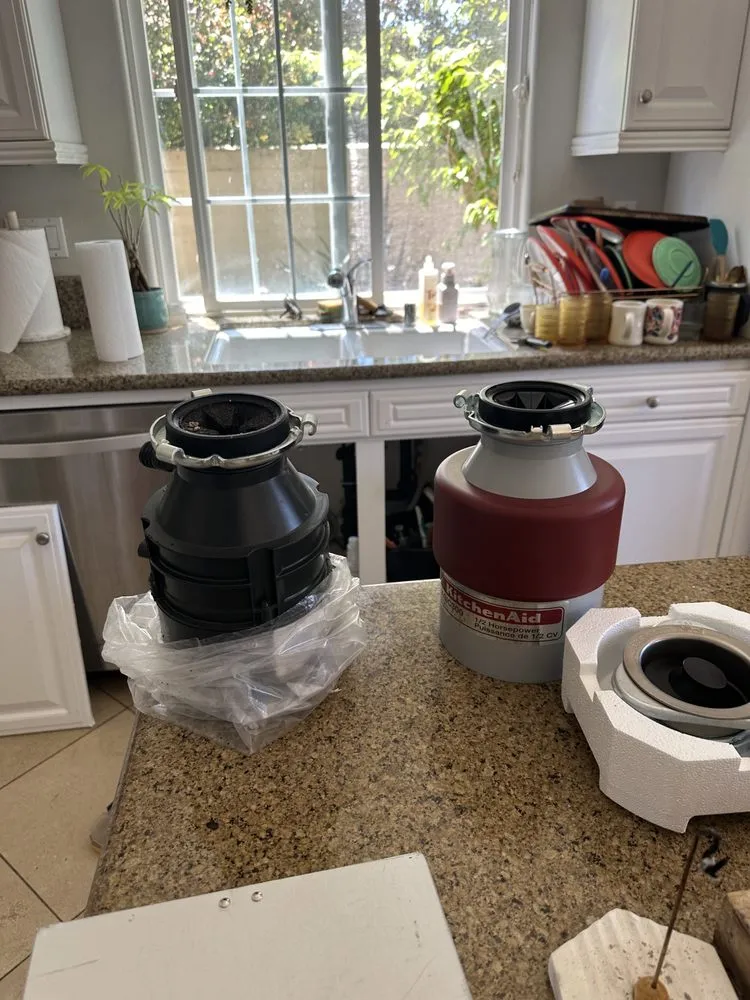
When replacement is the call, we handle both the removal of the old unit and installation of the new one, a full swap in Costa Mesa typically takes under an hour.
Garbage Disposal Brands We Service in Costa Mesa
We repair and replace all major disposal brands including InSinkErator, Moen, Waste King, KitchenAid, and Whirlpool. Whether your Costa Mesa home has a basic contractor-grade unit or a premium continuous-feed model, we carry the parts and have the experience to fix it right.