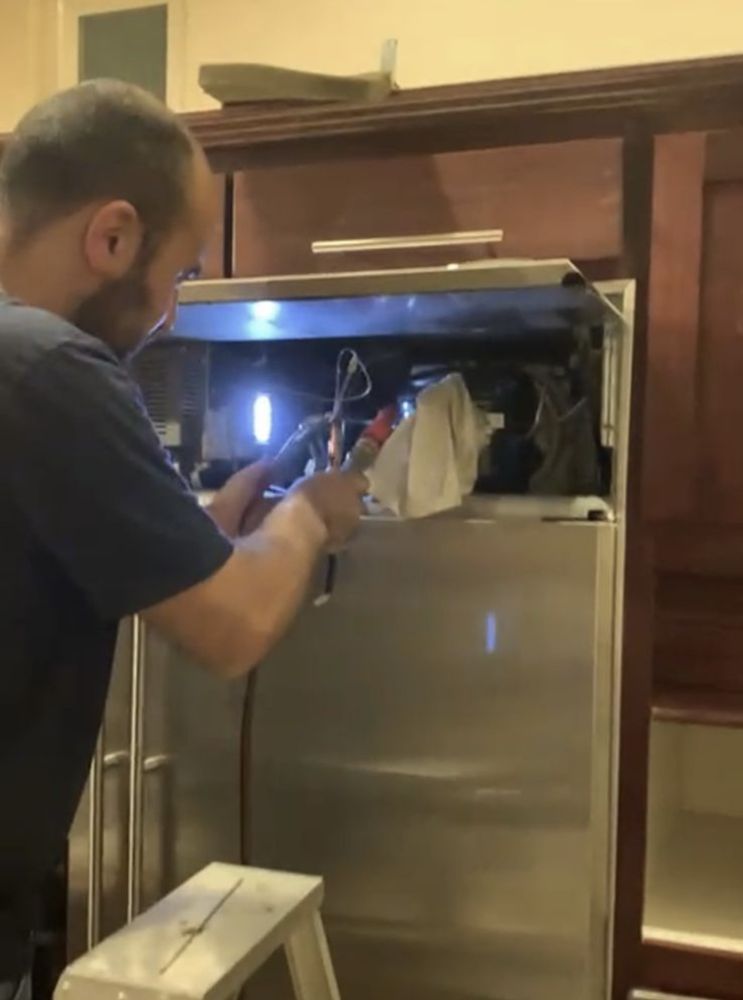
As technicians who've repaired thousands of appliances across Orange County, we get this question constantly. The honest answer is: it depends on three factors you can put actual numbers to: appliance age relative to expected lifespan, repair cost relative to replacement cost, and the energy efficiency gap between old and new. All three can be calculated before you decide.
The 50% Rule
The most widely used industry guideline is called the 50% Rule, repeated by the Association of Home Appliance Manufacturers (AHAM) as a rule of thumb and referenced in Consumer Reports repair guidance:
Use the rule with the actual numbers for your appliance. Start with a written repair estimate, then compare it with a current replacement-and-installation quote for a comparable model. Include any delivery, installation, cabinet, and disposal work in the replacement quote. The diagnosis, warranty coverage, parts availability, and prior repairs can all change the decision.
A diagnosis can distinguish an isolated repairable problem from a broader pattern of failures.
Appliance Age Matters More Than You Think
Every appliance has an average lifespan. If your appliance is near the end of that range, even a "cheap" repair may be a waste of money, you'll likely face another breakdown soon after. Lifespan estimates below come from the U.S. Department of Energy's 2023 and 2024 efficiency-standards rulemakings, which calculate a mean service life for each product class as a required input to the federal cost-benefit analysis.
Repair: When It's the Right Call
- The appliance is less than halfway through its lifespan
- Repair cost is under 50% of replacement cost
- The appliance is a high-end or hard-to-match model
- The issue is a single, isolated component
- You don't have budget for a replacement right now
- The appliance is past its expected lifespan
- Repair cost exceeds 50% of new appliance price
- You've had repeated repairs in the last 2 years
- Energy bills have noticeably increased
- Parts are hard to source or discontinued
Don't Forget Energy Efficiency
An older appliance that is running inefficiently can cost more per year in electricity than a modern ENERGY STAR unit. Factor in annual running costs when doing the math. ENERGY STAR's Flip Your Fridge calculator can estimate the energy and cost difference for a particular refrigerator.
If you're replacing rather than repairing, check whether rebates offset the cost. California utility programs (SCE, SoCalGas) and federal ENERGY STAR incentive programs funded through the Inflation Reduction Act offer rebates on qualifying high-efficiency appliances. Current offers vary by utility and model; search energystar.gov/rebate-finder or your utility's website for OC-specific amounts before you buy.
When Repair Becomes Riskier Than It Looks
One repair does not by itself predict another. A pattern of unrelated repairs, difficult parts sourcing, or a repair estimate close to replacement cost can make it useful to compare options. Specific signals to discuss with a technician include:
- Repeated or unrelated repairs. Review the prior repair history with the diagnosis rather than relying on a calendar threshold.
- A sealed-system failure. Compare the written repair estimate with a current replacement-and-installation quote for a comparable refrigerator.
- A control board failure. Verify the precise failed part and whether it is available before deciding.
- Discontinued or difficult-to-source parts. Parts availability can change both the scope and timing of a repair.
For practical guidance on what appliance age can and cannot tell you about a repair decision, see our appliance reliability and lifespan guide.
What the Data Says vs. What Your Gut Says
When an appliance breaks down, the first question should be what failed and what the repair will require. Service-life data can add context, but it cannot make the decision for an individual appliance.
Consumer Reports reliability surveys track what actually breaks and how often repairs succeed. Their data shows:
- A diagnosis should distinguish an isolated repairable problem from a broader pattern of failures.
- An isolated repair can be more practical than replacement when the written estimate is well below the current replacement-and-installation quote.
- Discuss the repair history with the diagnosis; it can provide useful context but cannot predict the next failure.
The energy efficiency calculation adds another dimension. The operating-cost difference from the Flip Your Fridge calculator (covered above) can change the math for a working-but-old refrigerator differently than it does for a broken 4-year-old one.
The data-driven framework:
- Start with a diagnosis and a written repair estimate.
- Compare it with the current replacement-and-installation cost of a comparable model.
- Include warranty coverage, parts availability, repair history, cabinet fit, and operating-cost information relevant to that model.
Typical 2026 Repair Costs in Orange County, by Appliance
The 50% Rule is only useful if you know what each repair actually costs. Here are the ranges we see most often in OC homes. Use them as a sanity check on any quote you receive.
Estimates vary by brand, part availability, and diagnosis. Final quote is provided before repair.
| Appliance | Common failure | Typical OC repair cost | Consider replacing when |
|---|---|---|---|
| Refrigerator (standard) | Defrost timer, ice maker module, fan motor | $200–$450 | Repair estimate approaches replacement-and-installation cost, or required parts are unavailable |
| Refrigerator (Sub-Zero / Viking / Thermador) | Drain tube clog, fan motor, gasket | $250–$700 | Compare the written repair estimate with a current replacement-and-installation quote for the exact model and opening |
| Washing machine | Drain pump, door latch, inlet valve | $150–$350 | Repair estimate approaches replacement-and-installation cost, or required parts are unavailable |
| Dryer (electric) | Heating element, thermal fuse, drum belt | $120–$280 | Repair estimate approaches replacement-and-installation cost, or required parts are unavailable |
| Dryer (gas) | Igniter, gas valve coils, thermal fuse | $150–$320 | Repair estimate approaches replacement-and-installation cost, or required parts are unavailable |
| Dishwasher | Drain pump, inlet valve, control panel | $150–$320 | Repair estimate approaches replacement-and-installation cost, or required parts are unavailable |
| Oven / Stove | Bake element, igniter, control board | $150–$420 | Repair estimate approaches replacement-and-installation cost, or required parts are unavailable |
| Microwave (built-in) | Magnetron, door switch, diode | $150–$280 | Compare the repair estimate with the current replacement-and-installation cost for the appliance type |
| Wine cooler | Thermostat, fan, compressor | $200–$500 | Repair estimate approaches replacement-and-installation cost, or required parts are unavailable |
Frequently Asked Questions
Premium Appliances: The 50% Rule Rarely Applies
Premium appliances need a model-specific comparison. Ask for a written repair estimate and a current replacement-and-installation quote for a comparable model, then consider the appliance's condition, cabinet fit, warranty coverage, and repair history.
Premium appliance owners have a second consideration that standard-appliance owners do not: these machines are designed for far longer service lives, and they are built to be taken apart and serviced. A 25-year-old Sub-Zero with a single failed component is a routine service call for us, not a replacement decision. In our own work we regularly source parts for premium units that old, Viking ranges and Miele dishwashers included, though availability varies by brand and model year, so it is worth checking on your specific model before committing to a repair.
For dishwashers specifically, see the cost breakdown in our dishwasher repair cost guide for Orange County. For Sub-Zero-specific repair vs. replace guidance, see our Sub-Zero repair or replace guide.
Get a Free Diagnosis First
The biggest mistake homeowners make is replacing an appliance before getting a repair quote. We've seen countless cases where a washing machine "stopped working" due to a clogged pump filter, a 20-minute fix that costs far less than a new machine.
Five questions to ask any technician before authorizing a repair:
- What specifically failed? A vague answer ("something electrical") is a red flag.
- Is this an OEM part or aftermarket? OEM parts typically carry longer warranties and better fit.
- Are there signs of other components wearing? A tech who checks nearby components is being thorough, not upselling.
- What is the warranty on parts and labor? Reputable shops warranty both, typically 90 days to 1 year.
- Given the age of the machine, do you recommend repair? A trustworthy technician will tell you when replacement makes more sense.
Before you shop for a replacement, call a certified technician. A proper diagnosis will give you the information you need to make a smart financial decision, not an emotional one. We serve all of Orange County, including Irvine, Anaheim, Santa Ana, Huntington Beach, Costa Mesa, Garden Grove, Lake Forest, Yorba Linda, Mission Viejo, Newport Beach, and all surrounding cities.
For appliance reliability and lifespan context, see our appliance reliability and lifespan guide. For documented lifespan data, see our 2026 appliance lifespan data guide. For the cost of skipping maintenance that shortens appliance life, see our maintenance skipping cost statistics.