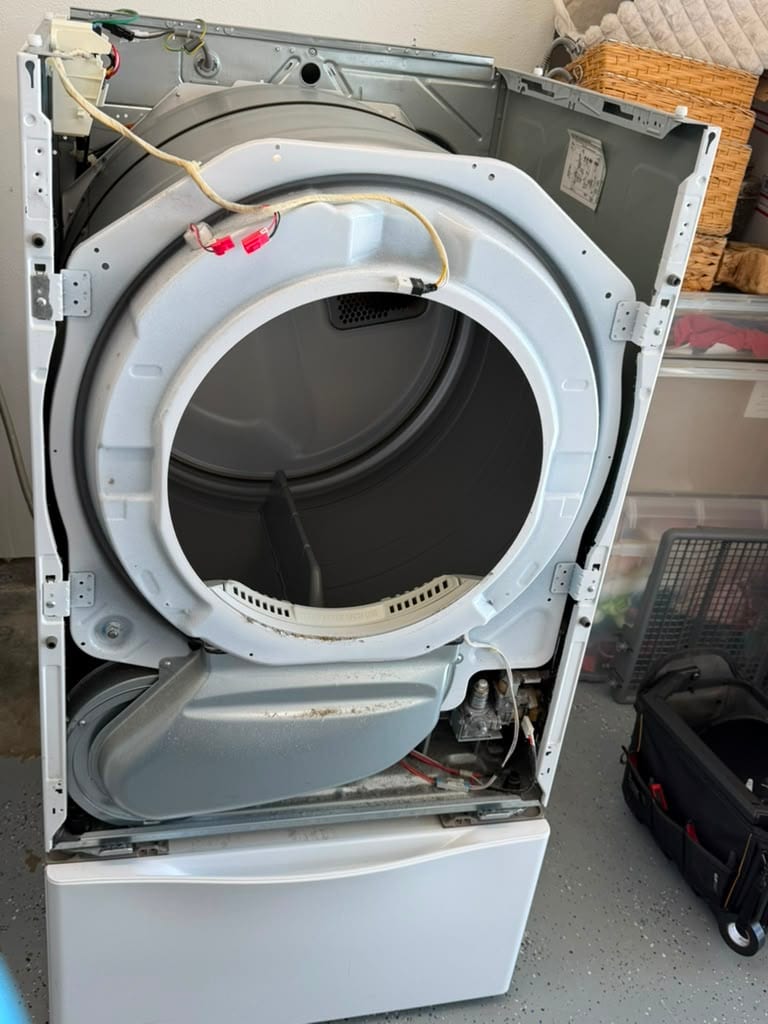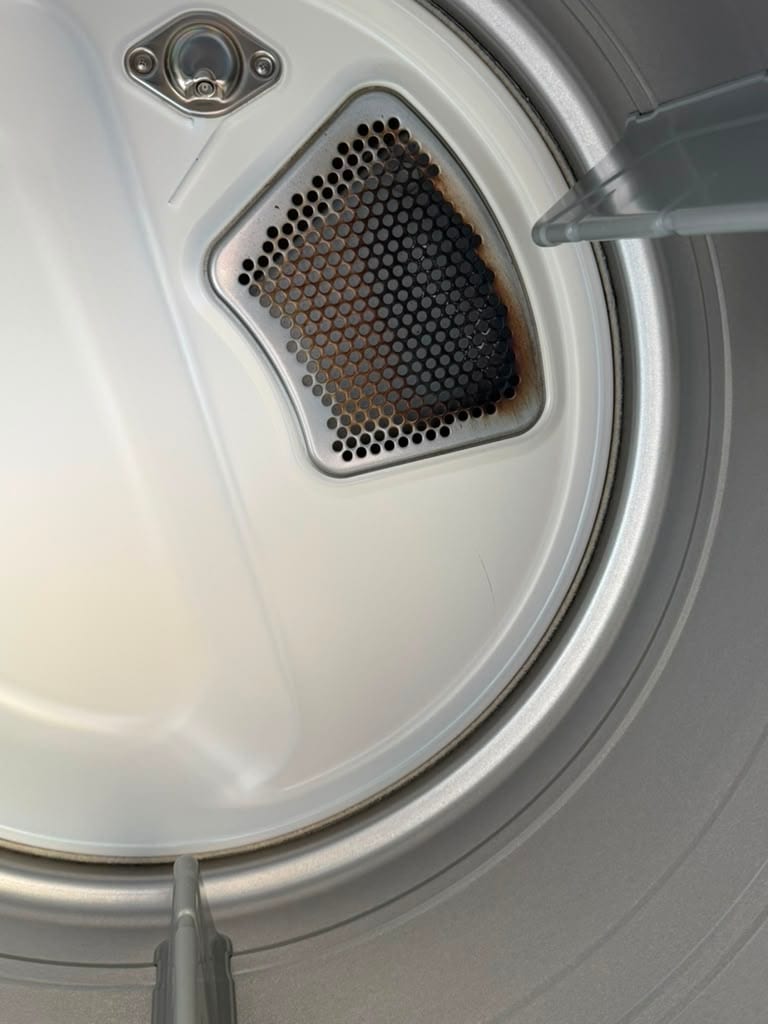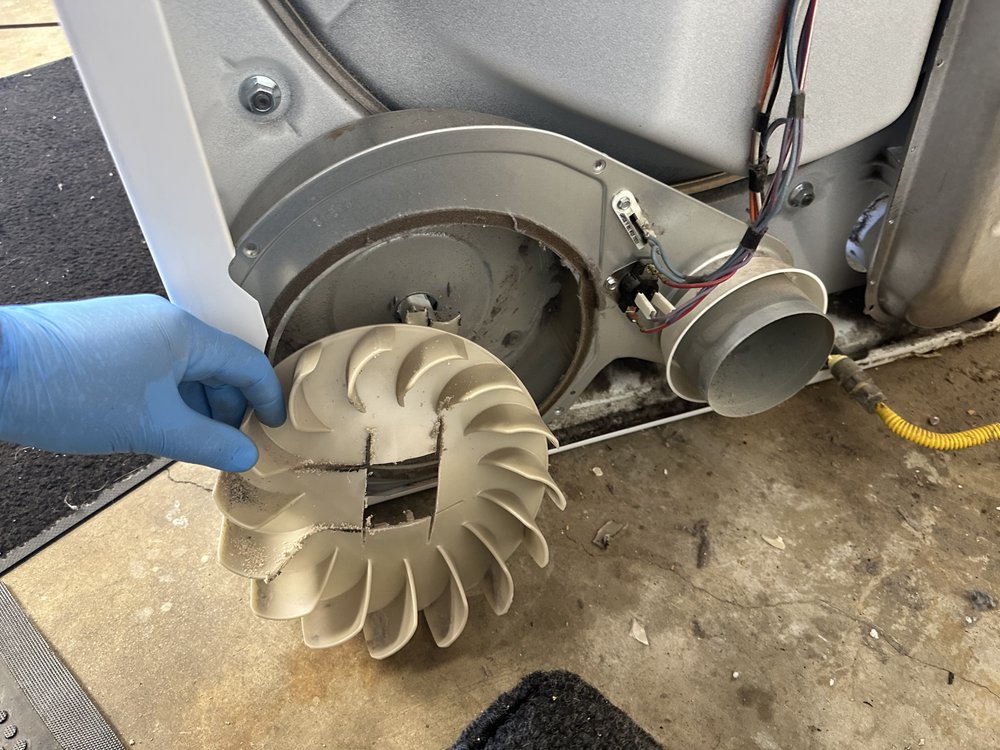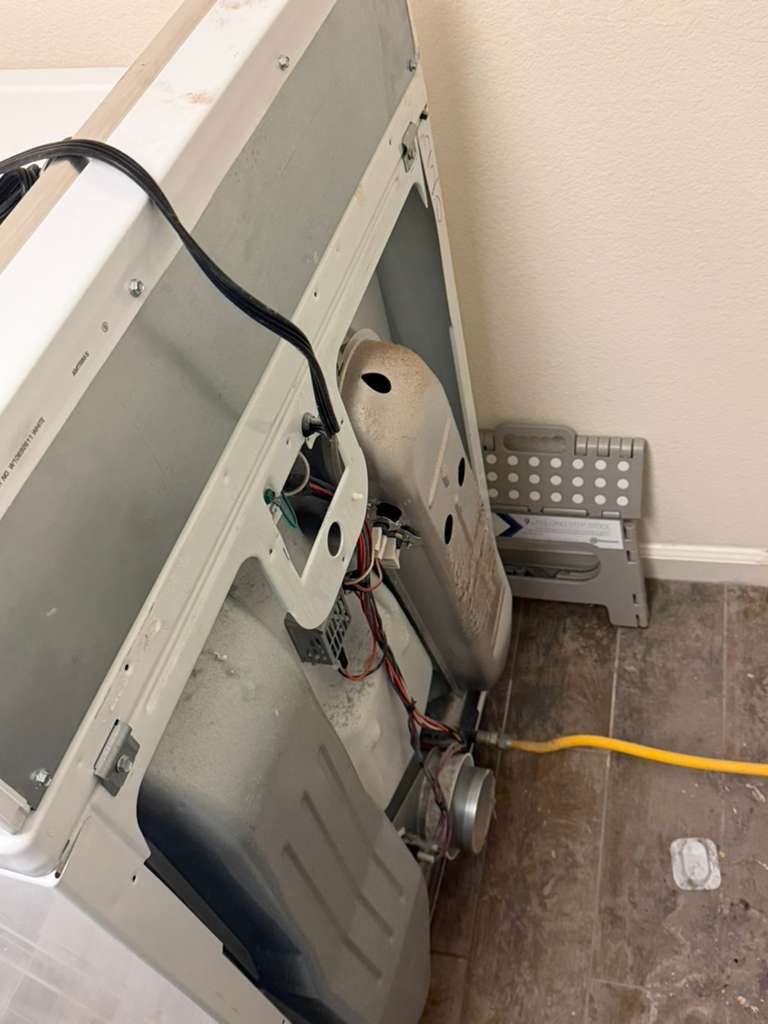
We fix this all over Lake Forest, from the Lake Forest I and II tracts near El Toro Road to the newer homes up in Foothill Ranch, Portola Hills, and Baker Ranch. The good news is that the drum turning means the motor is fine, so you are not looking at a major failure. The heat is a separate system, and when it quits, it comes down to a handful of parts. Let's go through the six, roughly in the order we find them, and note whether each one is a gas or electric issue.
A clogged lint vent choking the airflow
This is the root cause behind more no-heat calls than any single part. When lint packs the vent hose or the duct to the outside, hot air cannot escape, heat builds up, and a safety device shuts the heat off to protect the dryer. The drum keeps tumbling but runs cold. Pull the vent from the back, clear the hose and the wall duct, and check that the flap outside opens. This is do-it-yourself, and it is worth doing regardless, because a blocked lint vent is a real fire hazard.
Most commonA blown thermal fuse
The thermal fuse is a one-time safety part that blows when the dryer overheats, usually because of the clogged vent above. Once it blows, most dryers keep spinning but produce no heat at all. A new fuse is inexpensive, but here is the key: if you replace it without clearing the vent, the new one blows again within a load or two. That is why a technician always checks airflow first. Testing and replacing the fuse is a service call on most models.
Very commonA burned-out heating element (electric dryers)
On an electric dryer, a coiled heating element makes the heat. Over time the coil weakens and finally breaks, and once it does the dryer runs cold no matter what setting you pick. A broken element usually cannot be repaired, only replaced, and it needs a meter to confirm because the break is often invisible. This is one of the most common electric-dryer failures and a straightforward part swap for a technician.
Needs a proA failed thermostat or thermal cutoff
Dryers use a cycling thermostat to hold the right temperature and a high-limit thermostat or thermal cutoff as a backup that trips if things get too hot. When one of these fails, it can leave the heat circuit open and the dryer stops heating. Like the thermal fuse, a tripped cutoff is often the symptom of restricted airflow, so a good diagnosis checks the vent alongside the part. These test the same to the eye whether good or bad, so a meter settles it.
Needs a proA weak igniter or gas valve (gas dryers)
If you have a gas dryer, the heat comes from a burner lit by an igniter and fed by gas valve coils. A weak igniter that glows but does not get hot enough, or coils that fail to open the valve, leave the burner unlit and the clothes cold. You may hear the dryer try to light and give up. Diagnosing gas components safely means testing them under load, so this is a technician job, not a DIY guess.
Needs a proLost power on one leg of the 240-volt circuit
An electric dryer needs two 120-volt legs to make 240 volts for the heat. If one leg is lost, at a half-tripped double breaker, a worn outlet, or a loose cord connection, the motor still runs on the remaining leg but the heating element gets nothing. That is why a dryer can tumble perfectly yet never warm up. Flip the dryer breaker fully off and back on first; if that does not restore heat, the outlet or cord needs a closer look.
Sometimes DIYWhich causes you can fix yourself
Two of the six are genuinely do-it-yourself: clearing a clogged vent and resetting a half-tripped breaker. Those two solve a real share of no-heat calls, and clearing the vent is worth doing on a schedule regardless of the heat problem. If you have cleared the vent, confirmed the outside flap opens, and cycled the breaker, and the dryer in your Lake Forest laundry room is still running cold, the problem has moved past the easy fixes.
The other causes, a blown thermal fuse, a burned-out element, a failed thermostat, or a gas igniter, sit inside the cabinet and need a meter to diagnose without guesswork. Replacing the wrong part is expensive and does not restore the heat, and gas components in particular are not a safe DIY test. That is where a technician earns their keep. Our dryer repair service in Orange County handles both gas and electric no-heat diagnosis on every major brand.
Dryer running cold in Lake Forest?
If the vent is clear and the dryer still will not heat, we will pinpoint the part and fix it in one visit. Call or book online and tell us gas or electric.
Book a Dryer RepairWhat a repair visit looks like in Lake Forest
Knowing the steps takes the mystery out of it. Here is how a typical no-heat dryer call runs:
- Schedule. Book online or by phone. We reach Lake Forest from our Stanton base in roughly 35 to 45 minutes by way of the 5 and the 241, covering Foothill Ranch, Portola Hills, and Baker Ranch through Bake Parkway. You get a two-hour arrival window, not an all-day wait.
- Diagnose. The technician checks the airflow first, then tests the thermal fuse, heating element or igniter, and the thermostats with a meter. This usually takes 20 to 40 minutes and tells us exactly which part failed and whether the vent is the underlying cause.
- Quote. You get a written estimate before any work begins. Nothing gets added at the end.
- Repair. Common parts like thermal fuses, heating elements, thermostats, and igniters ride in the van, so most no-heat repairs finish on the spot. A rare control part is scheduled within one to three business days.
- Test. We run a heated cycle and confirm the dryer reaches temperature and holds it before we leave, and we make sure the vent is clear so the fix lasts.
Why it matters more than you think
A dryer that will not heat is more than an inconvenience. The most common cause, a clogged vent, is also the leading cause of dryer fires, so a no-heat dryer is often the machine warning you about a genuine hazard. Running cold loads over and over also wastes time and money, and the underlying overheating wears out fuses, thermostats, and the element faster. Catching it early, while it is still just cold clothes, keeps a small repair small and clears a fire risk. Lake Forest residents can reach us through our appliance repair in Lake Forest, CA page for same-day help.
We service every dryer brand, gas and electric
The no-heat problem shows up on every make, and the diagnosis follows the same path across all of them. We repair Whirlpool, GE, Samsung, LG, Maytag, Bosch, KitchenAid, Frigidaire, Kenmore, and Electrolux dryers throughout Lake Forest and the surrounding south Orange County cities, both gas and electric. Whether it is a stacked unit in a Serrano Highlands condo or a large-capacity pair in a Baker Ranch home, the fix starts with checking the airflow and testing the heat circuit to find what quit.
Frequently Asked Questions: Dryer Not Heating
Why does my dryer run but not heat?
The motor and the heat source are two separate systems, so the drum can spin fine while the heat is dead. The usual causes are a blown thermal fuse, a burned-out heating element on an electric dryer, a failed thermostat or thermal cutoff, or, on a gas dryer, a weak igniter or bad gas valve coils. A clogged vent is behind a surprising number of these, because trapped heat trips the thermal fuse or cutoff that is designed to shut the heat off before the dryer overheats.
Can a clogged vent cause a dryer to stop heating?
Yes, and it is one of the most common reasons. When lint blocks the vent, heat cannot escape and builds up inside the dryer. The thermal fuse or thermal cutoff, a one-time safety device, blows to stop the heat and protect the machine. The dryer keeps tumbling but runs cold. If we replace the fuse without clearing the vent, the new fuse blows again, so we always check airflow first. A clogged vent is also a genuine fire hazard, which is why it is worth clearing right away.
Is it worth repairing a dryer that is not heating?
Usually yes. The parts behind a no-heat dryer, the thermal fuse, heating element, thermostats, and igniter, are common and not expensive relative to a new dryer. On a machine under about 10 years old the repair is well worth it. Replacement only makes sense when the dryer is already near the end of its life or has a second major problem like a failing motor or bad bearings. A technician can tell you which situation you are in before you commit to parts.
What is the difference between a gas and electric dryer not heating?
An electric dryer makes heat with a heating element powered by a 240-volt circuit, so if one leg of that circuit is lost, the dryer runs but never heats. A gas dryer makes heat by burning gas, lit by an igniter and controlled by gas valve coils, so a weak igniter or failed coils leave it cold. Both types share a thermal fuse and thermostats, which fail the same way on either. Knowing which type you have narrows the diagnosis quickly.
How long does a dryer no-heat repair take?
Most no-heat repairs finish in a single visit. Once the technician confirms the failed part, common items like thermal fuses, heating elements, thermostats, and igniters ride in the van, so the fix usually takes 30 to 60 minutes on the spot. If the cause is a clogged vent, clearing it and testing takes a little longer. A rare control-board part may need to be ordered, which pushes the repair out one to three business days. See our full appliance repair in Lake Forest, CA page for the neighborhoods we cover.