How Wolf Range Igniters Work
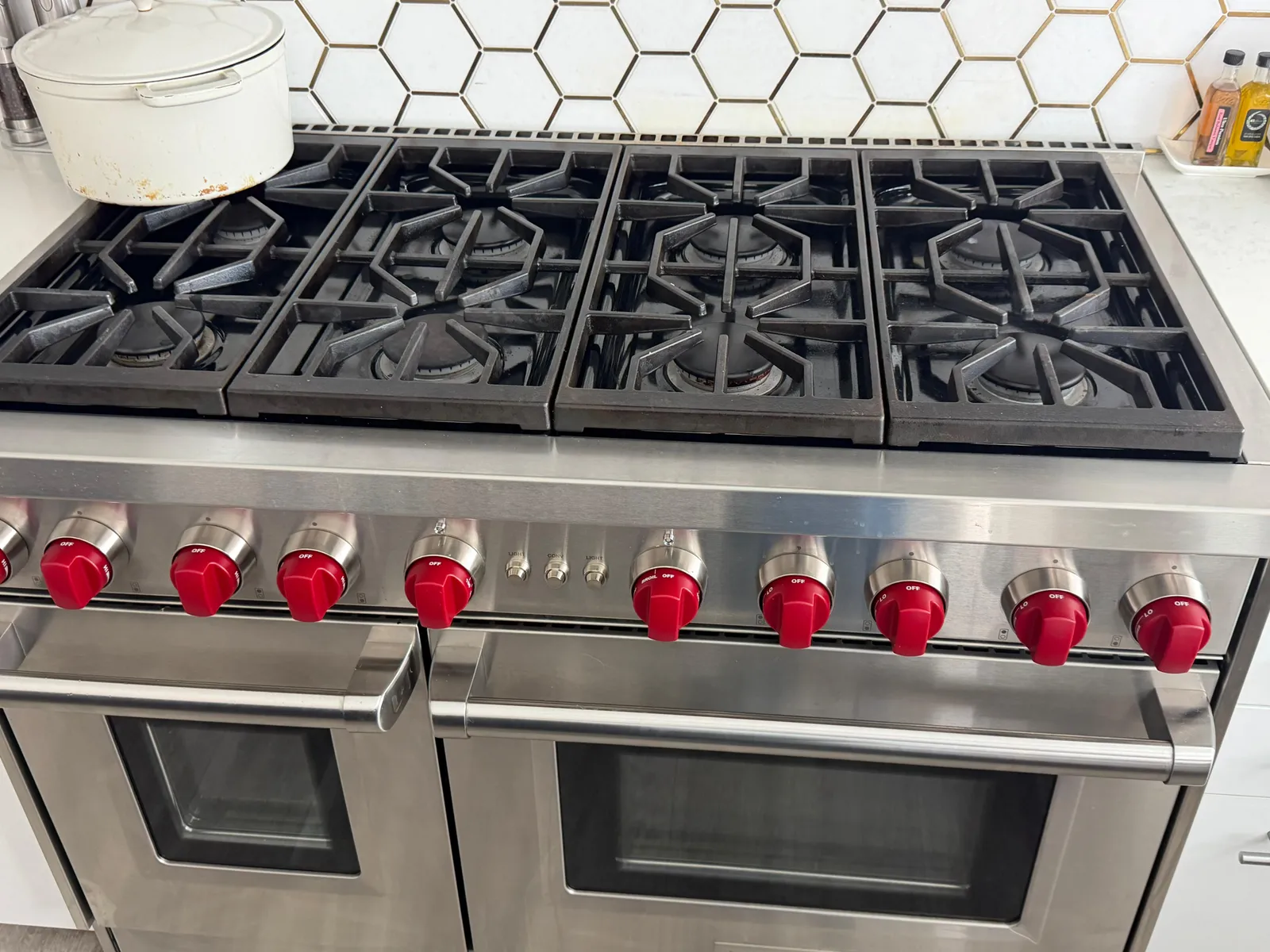
Wolf gas ranges use ceramic spark igniters positioned beside each burner head. When you turn the knob to the ignite position, a spark module sends a high-voltage pulse to every igniter simultaneously. The spark jumps from the ceramic tip to the metal burner head, igniting the gas at the burner port.
Two symptoms point in opposite directions and tell you where to start:
- Clicking but not lighting: the spark is reaching the igniter, but something is stopping combustion at the burner. This points to the igniter tip itself or the burner head.
- No clicking at all: the electrical side has failed. This points to the igniter switch for that burner, the spark module, or a power issue.
Knowing which symptom you have narrows the diagnosis before you open anything up.
The 4 Causes: Diagnosis by Symptom
Dirty or Clogged Igniter Tip
Symptom: one or more burners click but won't light, especially after a boil-over or heavy cooking session.
Food residue, grease, and starchy water coat the ceramic igniter tip and disrupt the spark path. A dirty igniter can produce a visible but weak spark that does not have enough intensity to catch the gas reliably. This is the most common Wolf igniter complaint and the most fixable.
Fix: remove the burner grate and cap, then clean the ceramic igniter tip gently with a dry toothbrush. Do not use water directly on the igniter. Let the area dry fully for at least 20 minutes before testing.
Moisture in the Igniter Assembly
Symptom: all burners click rapidly when you turn one knob, or the igniter produces a weak, inconsistent spark that dies immediately.
Water from a boil-over reaching the igniter housing, or excess moisture from cleaning, creates a conductive path that bleeds the spark away from the tip before it can jump to the burner head. You may also hear the range clicking on its own after cleaning, which means moisture entered the switch housing.
Fix: leave the range off with good ventilation for 30 minutes. For stubborn moisture, turn the oven on its lowest setting for 10 minutes to warm the interior, then off. Do not use the burners while drying. If moisture entered the spark module housing, the module itself may need replacement by a technician.
Failed Spark Module
Symptom: constant clicking even when no knob is turned, or complete silence on all burners at once.
The spark module is the central control board that generates the high-voltage pulse for all igniters. When it fails in one direction, it clicks continuously regardless of knob position. When it fails in the other direction, nothing clicks at all. Either way, all burners are affected simultaneously, which distinguishes this from a single-burner igniter switch failure.
Wolf uses OEM spark modules that are brand-specific. Aftermarket replacements cause persistent fitment and timing problems. Expect 2-5 business days for part sourcing from authorized distributors.
Repair cost: $350 to $700 parts and labor in Orange County, depending on the Wolf model series.
Failed Igniter Switch
Symptom: exactly one burner produces no click at all while all other burners spark normally.
Each burner position has its own igniter switch that tells the spark module to fire when the knob reaches the ignite position. When a switch fails, its burner goes silent while the rest of the range works normally. Switches wear out from repeated use or from moisture intrusion at the knob shaft. This is a precision repair: the knob and bezel must be removed carefully to access the switch housing without scratching the Wolf panel finish.
Repair cost: $200 to $450 parts and labor, depending on burner position and model.
What You Can Safely Check Yourself
Before calling a technician, work through this short list. Each step takes under five minutes and rules out the most common causes.
- Check the circuit breaker. Wolf igniters draw from a standard 110V circuit. A tripped breaker cuts power to the module entirely, silencing all igniters. Reset the breaker and test before assuming the module has failed.
- Reseat the burner cap. The burner cap must sit level and centered over the burner head. A rotated or lifted cap physically blocks the igniter port. Remove the grate, lift the cap, reseat it flat, and test.
- Clean the igniter tip. Use a dry toothbrush on the ceramic tip. Work around the igniter port with a wooden toothpick for packed debris. Do not use metal tools, which can crack the ceramic.
- Dry after cleaning. If you cleaned the cooktop surface with water, wait 20 to 30 minutes before testing. Residual moisture is the most common reason a newly cleaned Wolf range won't light.
- Check the gas supply. Confirm the shutoff valve behind the range is fully open. If other gas appliances in the home also fail, the issue is with the supply line, not the range.
If none of the self-checks restore ignition, the cause is inside the electrical assembly. At that point, the repair requires disassembly of the cooktop panel, access to the module or switch housing, and OEM replacement parts. A Wolf-experienced technician in Newport Beach, Laguna Beach, Irvine, or elsewhere in Orange County will have the common parts on the van for same-day completion in most cases.
Repair Costs in Orange County
Estimates vary by model, part availability, and diagnosis. Final quote provided before repair.
| Repair | Typical Cost Range | Notes |
|---|---|---|
| Service call / diagnostic: Orange County market average (often credited toward repair) | $95 – $150 | Our fee: $99 flat |
| Igniter cleaning (by technician) | $95 – $175 | Often combined with the diagnostic visit |
| Burner cap reseat and alignment | Included | Checked during every diagnostic visit at no extra cost |
| Igniter switch replacement (single burner) | $200 – $450 | OEM Wolf switch; labor varies by burner position |
| Spark module replacement | $350 – $700 | Affects all burners; model-specific OEM part required |
| Full igniter assembly (ceramic + housing) | $250 – $500 | When the ceramic tip is cracked or physically damaged |
Wolf range repairs sit at a higher price point than standard residential ranges for two reasons: OEM parts built to tighter tolerances than commodity alternatives, and a paneled cooktop design that requires careful disassembly to avoid surface damage. Both add real cost, and both are legitimate. A standard gas range igniter switch replacement runs $120 to $250; the Wolf equivalent runs $200 to $450 because the switch is brand-specific and the access labor is greater.
For context, a new Wolf range starts around $4,500 for an entry-level model and reaches $12,000 for a flagship dual-fuel. An igniter repair at any cost in the table above is well inside the 50% replacement threshold on every Wolf model currently sold. Unless the cooktop has multiple simultaneous failures or structural damage to the burner manifold, repair is the right economic call.
Our oven and stove repair service in Orange County covers Wolf, Viking, Thermador, and all major residential brands. We carry Wolf igniter components for the most common Pro Range and Dual Fuel series models. For Wolf-specific service across the full lineup (ranges, ovens, cooktops, and rangetops), see our Wolf appliance repair in Orange County page.
Frequently Asked Questions
Why is my Wolf range clicking but not lighting?
Clicking without ignition almost always means the ceramic igniter tip is dirty or wet. Food debris, grease, and boil-overs coat the igniter and interrupt the spark path to the gas. Clean the tip with a dry toothbrush, let it dry for 20 minutes, and retest. If clicking persists without ignition after cleaning, the igniter switch or spark module has likely failed and needs a technician.
Why does my Wolf range click constantly even when no knob is turned?
Constant unprompted clicking points to a failed spark module or moisture inside the igniter switch housing. The module controls when the spark fires; a failure causes continuous pulsing. Turn off power to the range at the breaker to protect the igniter ceramics and call for service. Do not continue running the range while this is happening.
Why does only one burner on my Wolf range not light?
A single silent burner while others spark normally is the igniter switch for that position. Each burner has its own switch that signals the module to fire. Clean the igniter and check the burner cap alignment first. If the burner still won't click after that, the switch needs replacement.
How much does Wolf range igniter repair cost in Orange County?
Our diagnostic fee is $99 and applies toward the repair. Expect $200 to $450 for an igniter switch replacement and $350 to $700 for a spark module. Most Wolf igniter repairs that don't require ordered parts complete same-day. If a part must be sourced, Wolf OEM components typically arrive in 2 to 5 business days. Estimates vary by model and diagnosis; a final quote is provided before any work begins.
Can I replace a Wolf range igniter myself?
Cleaning the igniter tip is safe and worth doing first. Replacing the switch or module is not recommended without appliance repair experience: Wolf uses proprietary OEM connectors, and incorrect installation can cause continuous arcing or prevent the safety interlock from working correctly. Our technicians carry the most common Wolf igniter parts and can complete the repair in a single visit.