Your built-in refrigerator is the hardest appliance in your kitchen to replace. Replacement and installation costs vary by model, paneling, delivery, and cabinet work. Compare a written repair estimate with a current quote for your exact opening. But built-in refrigerators also require a different level of technical skill than a standard freestanding fridge. Removing a paneled unit from a custom cabinet surround without damaging the cabinetry takes experience. Diagnosing a dual-compressor system takes the right equipment.
This guide covers what makes built-in refrigerator repair different, what each major luxury brand looks like from a service perspective, what common failures cost, and how to spot the warning signs that it is time to call a technician in Orange County. If you own a GE Monogram built-in, see our dedicated GE appliance repair service across Orange County.
What Makes Built-In Refrigerators Different to Repair
Custom panels and integrated cabinetry
Most built-in refrigerators have custom wood or stainless panels attached to the doors that match the surrounding kitchen cabinetry. Before a technician can access the appliance, those panels need to come off carefully, the unit needs to be slid or lifted out of its enclosure, and any connection points, water lines, or drain lines need to be disconnected without damage to the surrounding woodwork. That extraction step alone adds 30 to 60 minutes of labor compared to a freestanding unit where the technician walks up and starts diagnosing immediately.
In Newport Beach and Laguna Beach homes where the cabinetry itself costs more than the appliance, this step requires experience and care. A technician who is not accustomed to working around custom millwork can cause expensive collateral damage.
Dual-compressor and dual-evaporator systems
Entry-level built-in refrigerators use a single compressor. Flagship units from Sub-Zero and many Thermador and Miele models use dual-compressor or dual-evaporator systems that keep the refrigerator and freezer zones fully independent from each other. This separation is excellent for food preservation, but it doubles the diagnostic surface. When a built-in is not cooling correctly, the technician needs to determine which zone is affected, whether the two compressors are operating independently, and whether the issue is in the sealed system, the defrost cycle, or the electronic controls.
Sealed installs and ventilation constraints
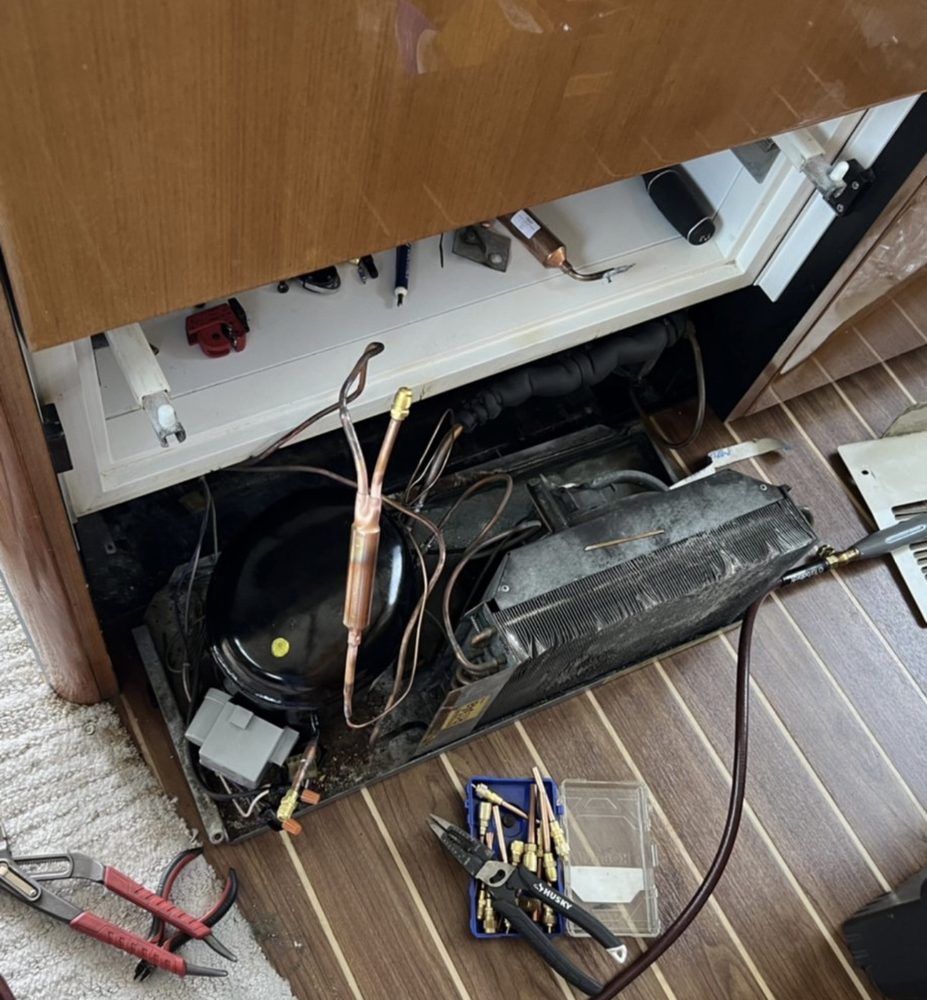
Built-in refrigerators are designed to fit flush with surrounding cabinetry, which means ventilation happens through a base grille rather than through clearance around the sides and back. When that grille becomes blocked with dust, pet hair, or debris, the compressor overheats. In OC homes with pets or near construction, condenser cleaning every 3 to 6 months is not optional. It is the single most effective maintenance step for extending the life of any built-in unit.
Sub-Zero Built-In Refrigerator Repair
The benchmark for built-in longevity
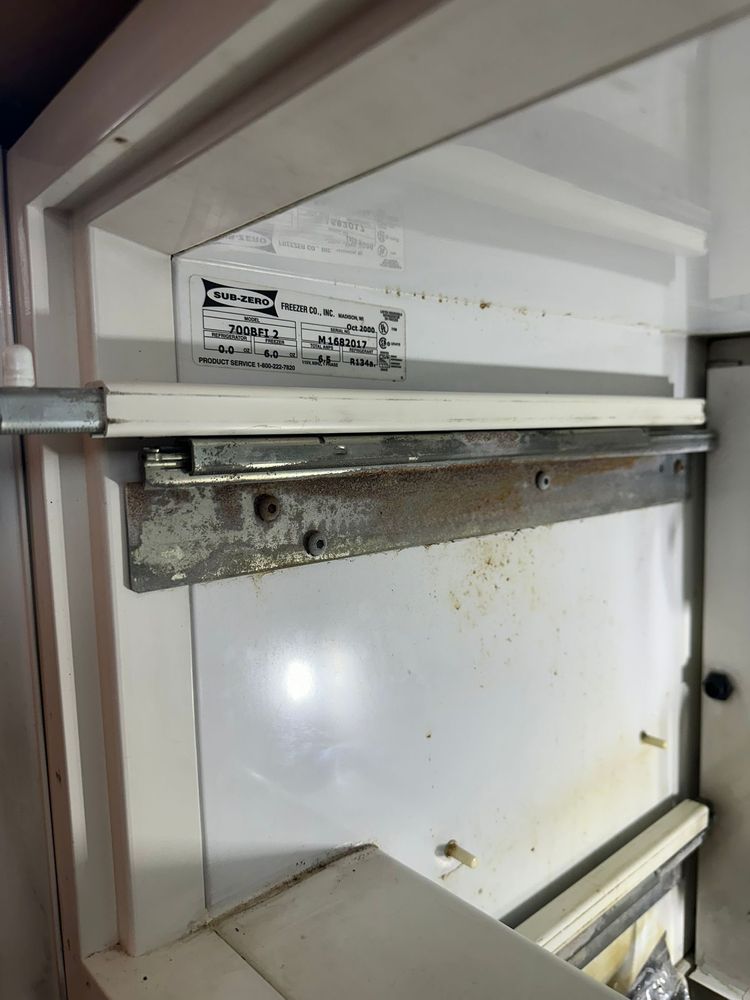
Sub-Zero refrigerators are manufactured in Wisconsin with a design philosophy of extreme longevity. Their dual-compressor flagship series isolates the refrigerator and freezer on independent circuits, meaning a failure in one zone does not affect the other. Many Sub-Zero units in Orange County are 20 or 25 years old and still cooling correctly after one or two service calls over their lifetime.
Common Sub-Zero failures we see in OC homes:
- Dirty condenser coils causing compressor overheating and cycling issues
- Worn door gaskets on the refrigerator or freezer column allowing humidity intrusion
- Defrost system failures leading to ice buildup on the evaporator coil
- Condenser fan motor failure causing temperature fluctuations
- Control board failures on older units (SZ-300 and SZ-500 series)
- Sealed-system or compressor failure on units past 15 years without condenser maintenance
Parts availability for Sub-Zero is excellent. Sub-Zero manufactures in the US and maintains a strong parts supply chain. A condenser fan motor for a Sub-Zero 700 series is not the hunt it might be for a discontinued European brand.
For our full Sub-Zero repair coverage in Orange County, see our Sub-Zero appliance repair Orange County hub.
Thermador Built-In Refrigerator Repair
Freedom hinge and flush installation
Thermador built-in refrigerators use the Freedom hinge system, which allows cabinet-depth flush installation with full door swing. The door alignment and hinge tension on Thermador units are more sensitive than on Sub-Zero, and hinge adjustment is a common service call after the unit has been in place for several years. Thermador also uses an active condensate management system that routes defrost water through a heated drain line; when that heater fails, water can pool inside or under the unit.
Common Thermador built-in failures:
- Door alignment issues and Freedom hinge wear after 8 to 10 years
- Condensate drain heater failure causing water accumulation
- Compressor noise on T18 and T24 series units (often vibration isolation pads)
- Ice maker module failure on Thermador French-door columns
- Electronic control board errors (E-series fault codes)
Thermador is owned by BSH (Bosch-Siemens Hausgeraete), so it shares parts and service infrastructure with Bosch and Gaggenau. A technician familiar with one BSH platform typically works well across all three brands.
See our Thermador appliance repair Orange County hub for the full scope of services we provide for this brand.
Miele Built-In Refrigerator Repair
Precision engineering, specific diagnostics
Miele's built-in refrigerators use proprietary electronic control systems that display fault codes when something fails. This specificity is actually an advantage: when a Miele shows an F-code, a qualified technician can often identify the exact failed component before opening the unit. Miele's build quality is exceptional, and the failure rate on structural components is low. The service calls we see most often on Miele refrigerators are electronic rather than mechanical.
Common Miele built-in refrigerator failures:
- Control board or display module faults (F-series error codes)
- Temperature sensor drift causing inaccurate readings
- Ice maker failures on Miele KFN series
- Door seal wear on NoFrost models
- Compressor and sealed-system issues on units past 15 years
Miele parts are available through authorized distributors, but lead times can be longer than Sub-Zero or Thermador for some components. For non-urgent repairs, we recommend ordering parts at the time of diagnosis rather than waiting to see if the issue resolves.
Learn more about our Miele appliance repair Orange County service coverage.
Common Built-In Failures Regardless of Brand
Despite their engineering differences, Sub-Zero, Thermador, and Miele built-in refrigerators share a common set of failure patterns. These are the issues we resolve most often across all three brands in Orange County homes.
- Condenser coil blockage. The number one preventable failure across all built-in refrigerators. Dust and pet hair accumulate on the condenser coil behind the base grille. The compressor compensates by running hotter and longer until it fails prematurely. Clean the coil twice a year.
- Door gasket wear. The magnetic door seal degrades over time, especially on refrigerators that are opened frequently. A failing gasket allows warm, moist air to enter, causing the compressor to run continuously and frost to form in unexpected places. The paper test (close the door on a piece of paper and see if it slides out) works on built-in units the same as on any refrigerator.
- Defrost system failure. All frost-free built-in refrigerators cycle through a defrost sequence every 8 to 12 hours. When the defrost heater, defrost thermostat, or defrost timer fails, ice accumulates on the evaporator coil until it blocks airflow entirely. The symptom is a refrigerator that cools poorly even though the compressor is running. This is a common, fully repairable failure.
- Evaporator fan motor failure. The evaporator fan circulates cold air from the coil into the refrigerator compartment. When it fails, the refrigerator stops cooling while the freezer may remain functional (if the two zones share the same fan) or also deteriorates. The fan is typically accessible from inside the freezer compartment.
- Control board failure. Electronic control boards on luxury built-in refrigerators last 10 to 20 years on average, but power surges, voltage fluctuations, and moisture intrusion can shorten their lifespan. A failed control board often presents as a unit that powers on but displays error codes or fails to regulate temperature correctly.
Why DIY Is Risky on Built-In Refrigerators
DIY refrigerator repair can be reasonable on a freestanding unit where access is straightforward and parts are inexpensive. On a built-in, the risk profile is different.
Removing a paneled built-in from a custom enclosure without experience risks cracking the custom panel, scratching the surrounding cabinetry, or bending the hinge system. Any of those damages can cost more to repair than the original appliance service call. Built-in refrigerators also often require partial cabinetry removal to get enough clearance to slide the unit out, which adds another layer of complexity.
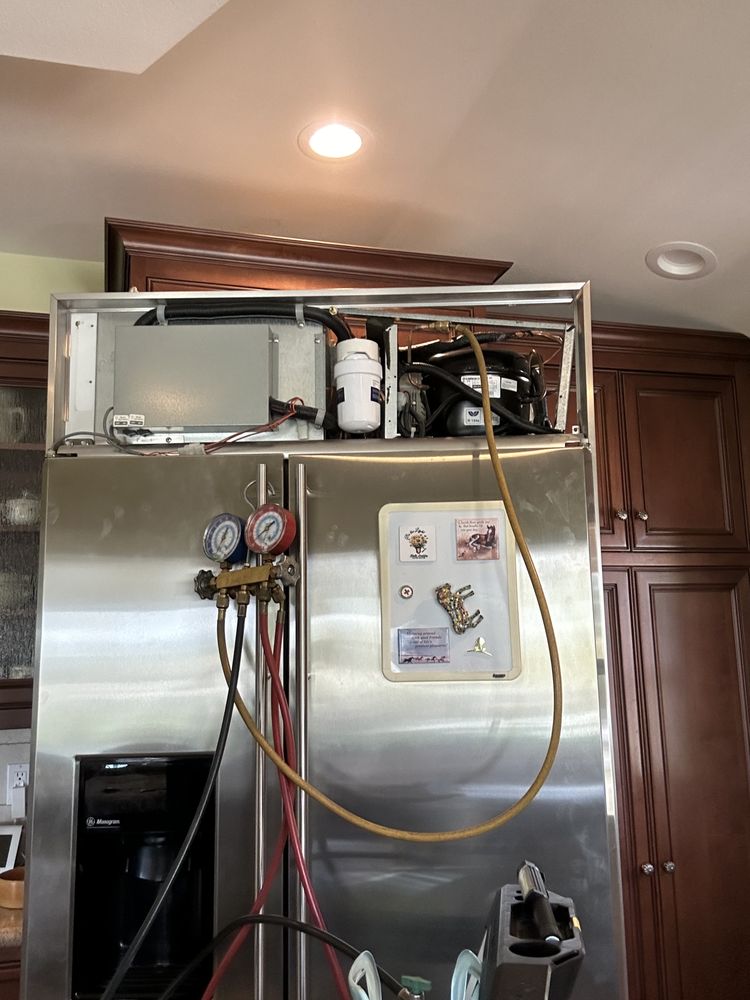
On Sub-Zero and Miele units with sealed systems, any repair involving refrigerant requires EPA Section 608 certification. This is not a legal technicality: refrigerant handling done incorrectly voids the manufacturer warranty and can damage the sealed system in ways that turn a $400 repair into a $2,400 compressor replacement.
For condenser coil cleaning, door gasket inspection, and temperature verification, a homeowner with moderate DIY skill can do these safely on most built-in units without removing the refrigerator from its enclosure. For anything beyond that, the labor cost of a professional service call is worth the protection it provides on a $10,000 appliance.
Typical Repair Costs for Built-In Refrigerators in Orange County
Estimates vary by brand, part availability, and diagnosis. Final quote is provided before repair.
These are the ranges we see most often in OC homes. Use them as a reference when evaluating a quote from any service provider.
| Repair | Typical OC cost range | Notes |
|---|---|---|
| Service call / diagnostic (credited toward repair if you proceed) | $95–$150 | Our fee is $99 flat |
| Condenser coil cleaning | $100–$200 | Often done during the service call |
| Door gasket replacement | $250–$450 | Higher for Sub-Zero column doors with integrated panels |
| Defrost system (heater, thermostat, or timer) | $300–$600 | Often combined with evaporator cleaning |
| Evaporator fan motor | $400–$750 | Labor-intensive on some integrated models |
| Condenser fan motor | $350–$650 | Common failure on Sub-Zero 700 and Pro 48 series |
| Electronic control board | $600–$1,400 | Miele and Sub-Zero boards can be at the high end |
| Ice maker module | $250–$500 | Thermador and Sub-Zero ice makers vary widely by series |
| Sealed-system / compressor replacement | $1,200–$2,400 | Requires EPA Section 608 certification; most repairs are worth it given replacement costs |
For more context on when repair makes financial sense versus replacement for refrigerators specifically, see our Sub-Zero repair vs. replace guide. For a full breakdown of Sub-Zero repair costs in Orange County, see our Sub-Zero repair cost article.