Quick Diagnosis: Gas vs Electric
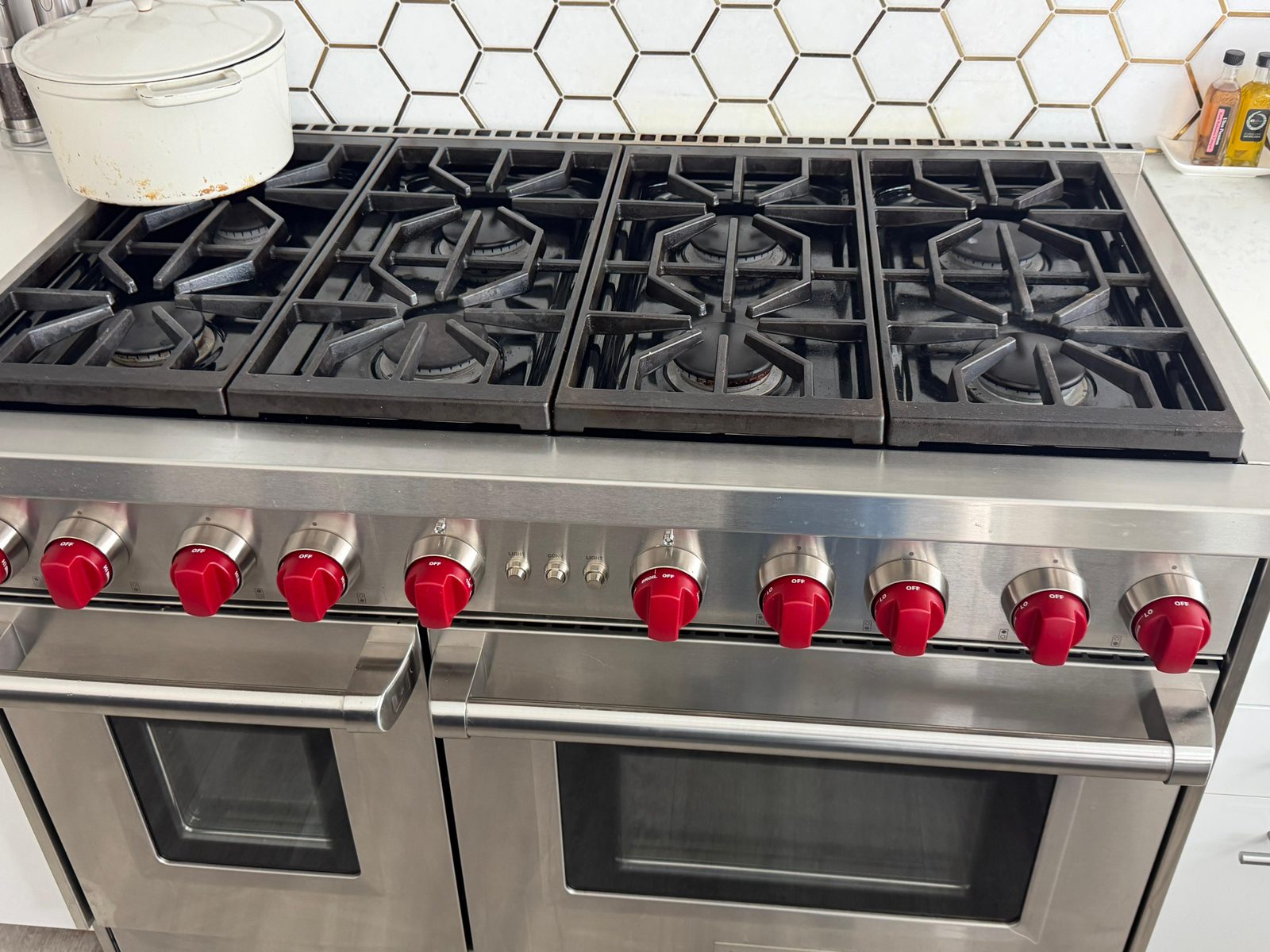
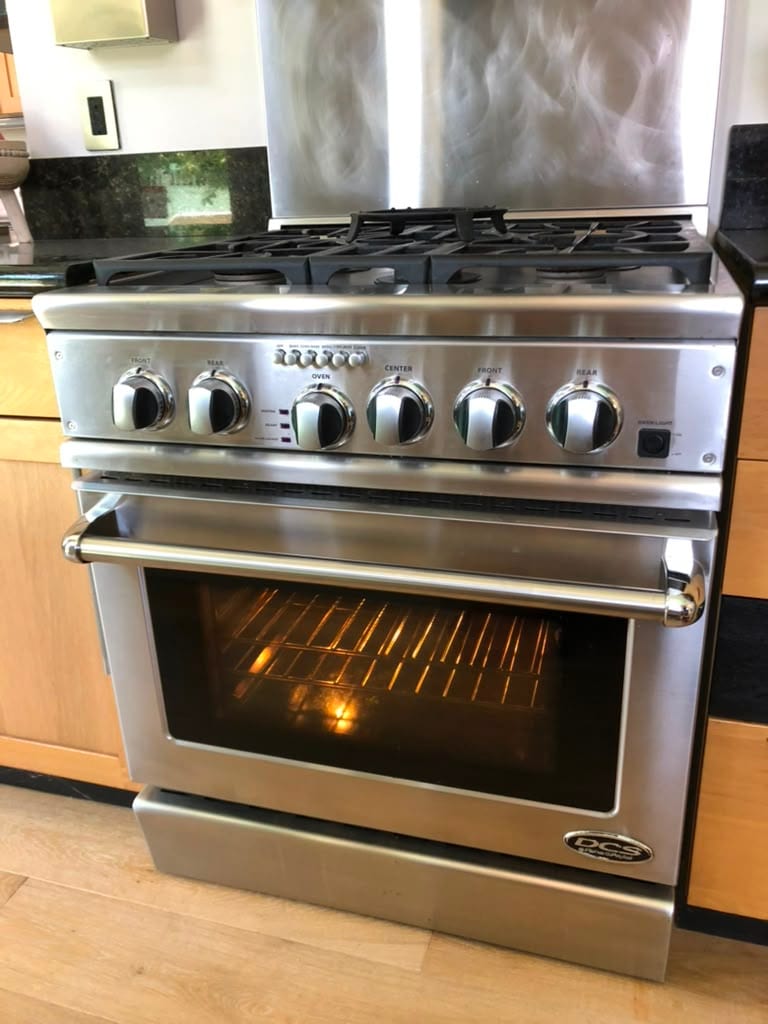
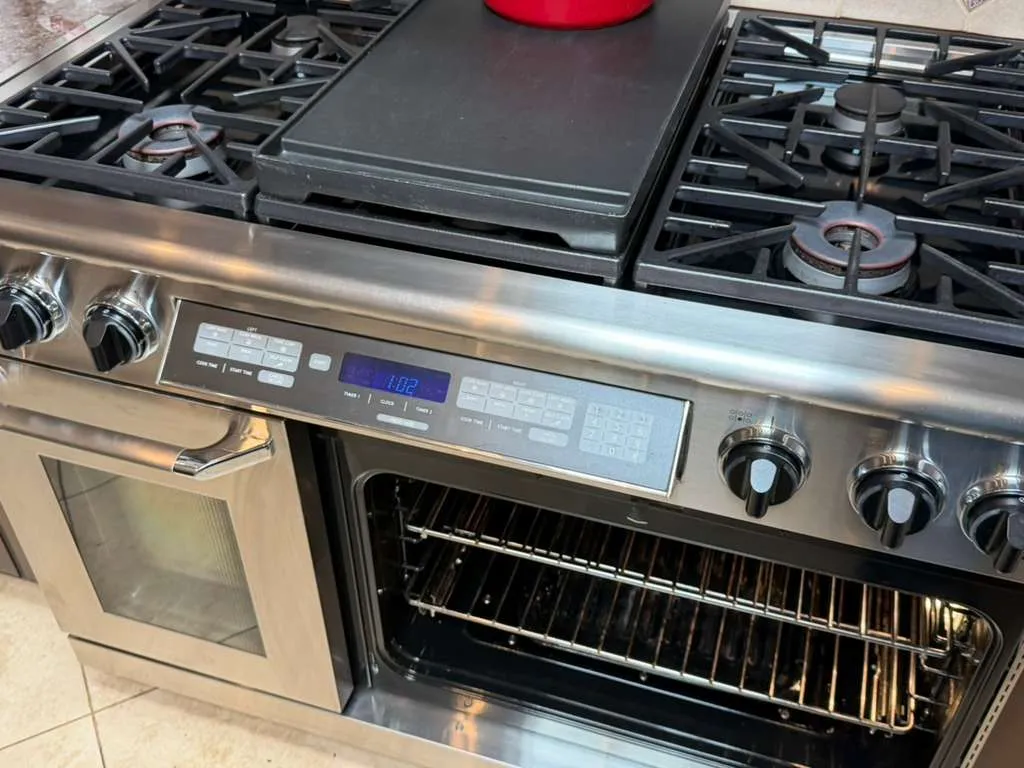
Dacor builds gas ranges, dual-fuel ranges, and electric wall ovens, and the most likely failure depends on which type heats your oven cavity. Before working through the full cause list, identify what you have.
Gas and dual-fuel Dacor ovens (Renaissance, Discovery, Distinctive, and Modernist series) use a hot surface igniter to light the bake burner at the bottom of the cavity. The igniter has two jobs: it glows to create the ignition point, and it draws enough current to signal the safety gas valve to open. When it weakens, you will often see it glow orange without the burner ever catching. That "glows but never lights" pattern is the classic Dacor gas-oven failure.
Electric Dacor ovens (electric wall ovens, and the oven cavity on dual-fuel ranges) use a bake element at the floor and a broil element at the ceiling. If bake produces no heat but broil still glows, the bake element is almost certainly the culprit. If neither heats, the problem is upstream: a tripped breaker, a failed thermal fuse, or the control board.
For an overview of everything we cover on ranges and wall ovens, see our oven and stove repair page for Orange County.
Causes Ranked by Likelihood
Hot Surface Igniter
Dacor gas and dual-fuel ovens use a silicon-carbide hot surface igniter, not a spark igniter. Newer Modernist-family ranges use a round-style igniter; older Heritage and Renaissance-era units use a flat design. The two are not interchangeable, so a replacement has to match the specific model.
Symptoms: Broiler may work while bake does not; the igniter glows visibly but the burner never lights; ignition takes far longer than the normal 60 to 90 seconds; you catch a brief puff of gas followed by nothing.
Confirmation test: The igniter must draw enough current to open the gas valve's safety solenoid, typically 3.2 to 3.6 amps. As the element ages, its resistance climbs and amp draw falls; below about 3.0 amps the valve will not open even though the igniter still glows. A technician confirms this with a clamp-on ammeter during a bake cycle, or checks the igniter for continuity with the power off.
Repair cost: $240 to $480. Estimates vary by brand, part availability, and diagnosis. Final quote is provided before repair.
Bake Element
On electric Dacor wall ovens and the oven cavity of dual-fuel ranges, the bake element is the coil at the floor of the oven. It carries a heavy electrical load, so failures are often visible: look for blistering, a break in the coil, or a burned spot. The extreme heat of a self-clean cycle is frequently what finally kills an aging element.
Symptoms: Oven does not heat from below; food does not brown on the underside; the element does not glow uniformly red; broil mode still works normally.
Confirmation test: Start with a visual inspection. Then, with power off and the element leads disconnected, test for continuity with a multimeter. A good bake element reads roughly 20 to 70 ohms; an open circuit (infinite reading) confirms the element has burned out.
Repair cost: $200 to $350. Estimates vary by brand, part availability, and diagnosis. Final quote is provided before repair.
Oven Temperature Sensor (RTD Probe)
The RTD (resistance temperature detector) is a thin metal probe mounted at the rear top of the oven cavity. It continuously reports temperature to the control board. If the sensor reads an invalid value, the board withholds heat as a safety measure, so the oven may never climb to temperature or may not heat at all.
Symptoms: Oven runs far hotter or cooler than the set point; preheat takes much longer than usual; food cooks unevenly; the display shows an F3 (shorted sensor) or F4 (open sensor) fault code.
DIY test: With the oven cold and near 72 degrees Fahrenheit, measure resistance at the sensor connector. It should read about 1,080 to 1,100 ohms. An open circuit, a near-zero reading, or a value well outside that range means the RTD has failed. Inspect the sensor harness and connector before condemning the probe.
Repair cost: $150 to $300. Estimates vary by brand, part availability, and diagnosis. Final quote is provided before repair.
Relay Board or Control Board (F1 Error)
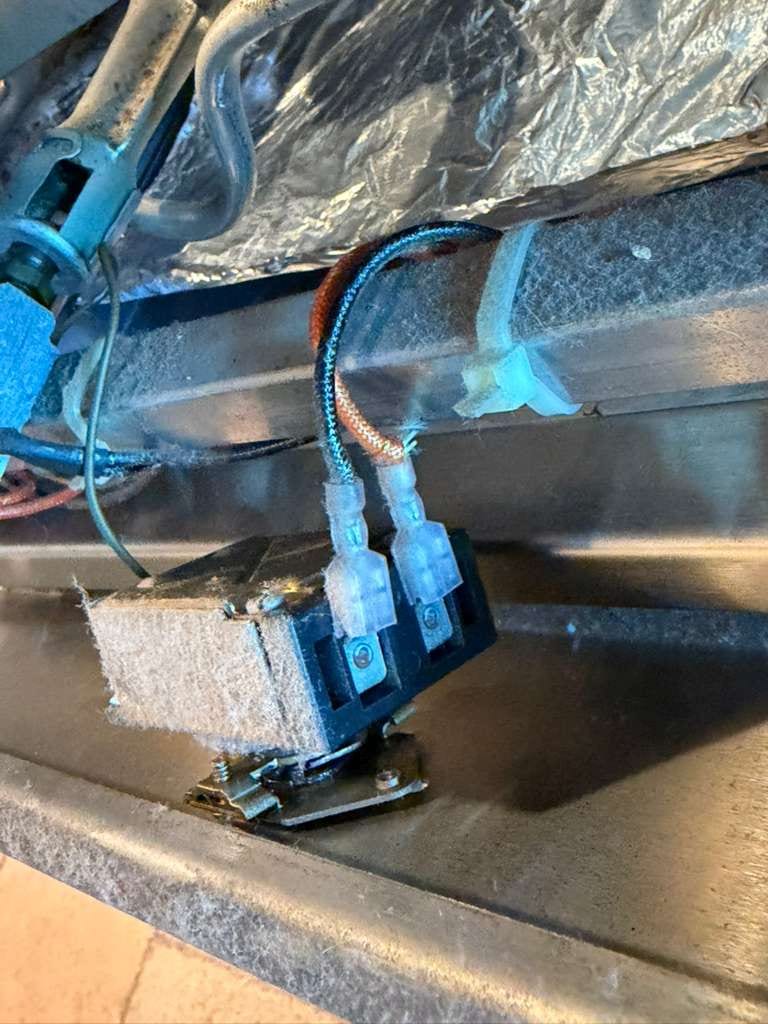
The electronic control board, and on some Dacor models a separate relay board, sends voltage to the elements or igniter. A failed relay cannot pass that current, so a perfectly good element or igniter still gets no power. This is a known, recurring weak point on Dacor ovens. One documented failure mode: a relay-board connector clip works loose and the resulting heat melts the insulating sleeve, causing no heat or a temperature-limited oven.
Symptoms: No voltage at the element or igniter terminals despite a good part; intermittent faults; an F1 error on the display; the oven will not reach temperature.
Confirmation test: This is largely diagnosis by elimination. If the element, igniter, and RTD all test good but there is no voltage at the element terminals during a call for heat, the board or a relay is the cause. As a first step for an F1, cut power at the breaker for at least three minutes, then restore it to reset the board. If F1 returns, the board needs professional repair or replacement.
Repair cost: $350 to $700. Estimates vary by brand, part availability, and diagnosis. Final quote is provided before repair.
Our Dacor appliance repair team in Orange County diagnoses igniter, sensor, and board faults in one visit so a good part is never swapped to chase a board problem.
Thermal Fuse or High-Limit Thermostat
The thermal fuse and high-limit thermostat are safety devices that cut power to the oven if it overheats. The most common trigger is a self-clean cycle: its extreme heat can trip the fuse or thermostat, or prompt the control board to lock out heating entirely. That is why a Dacor oven so often goes cold immediately after a self-clean.
Symptoms: Oven worked fine, then stopped heating right after a self-clean cycle; no heat at all with an otherwise normal-looking display.
DIY test: Some Dacor models have a red reset button near the temperature safety device; press it (sometimes twice, until it clicks) to restore heating after a self-clean lockout. A technician can also test the thermal fuse for continuity; an open fuse confirms it has blown. If the fuse keeps blowing, there is an underlying overheating cause to find.
Repair cost: Often resolved with the reset; otherwise part replacement falls in the $150 to $300 range. Estimates vary by brand, part availability, and diagnosis. Final quote is provided before repair.
DIY Checks You Can Do Today
Before scheduling a service visit, run through these checks. Several Dacor oven heating problems can be identified, and a few resolved, without tools.
- Reset the control board. For an F1 or any frozen display, cut power at the breaker for at least three minutes, then restore it. This clears many one-time faults.
- Look for the self-clean connection. If the oven quit right after a self-clean, check for a red reset button near the safety thermostat and press it until it clicks. That alone restores heat on many Dacor models.
- Test broil to isolate the bake element. On electric and dual-fuel ovens, set the oven to broil. If the top element glows red within two minutes, power is reaching the oven and the bake element is the likely failed part.
- Watch the igniter on gas models. Set the oven to bake at 350 degrees and watch through the window. If the igniter glows for more than 90 seconds without lighting the burner, it is too weak to open the gas valve.
- Inspect the bake element visually. Pull the racks and look at the element on the oven floor. Blisters, a break in the coil, or a burned spot confirm failure without any tools.
- Note any fault codes. Write down an F1, F3, or F4 code exactly as it appears; it tells your technician whether to look at the relay circuit (F1) or the temperature sensor (F3 or F4) first.
Pro Repair Scope
A few Dacor oven repairs are reasonable for a confident homeowner; most are not. Here is how the work breaks down.
Bake element replacement: Possible as a DIY task on electric ovens if you are comfortable working around 240-volt circuits with power disconnected at the breaker. The correct OEM part number matters, because Dacor elements are not universal across series. The terminal connections can sit awkwardly deep in the cavity on some wall ovens.
Gas hot surface igniter: More involved. It requires accessing the bottom of the oven cavity, removing the burner cover, and replacing the igniter while routing the wiring correctly. Matching the round or flat igniter style to your model is essential, and a technician confirms the gas connections are seated before relighting.
Temperature sensor, relay board, and control board: These call for disassembly beyond typical homeowner work. The RTD probe has to be routed correctly; board replacement requires full panel disassembly and careful harness reconnection. The recurring Dacor relay-board fault in particular should be diagnosed by a technician, because a good igniter or element is easily mistaken for a board that is silently failing to pass current.
Our team services Dacor ranges, dual-fuel ranges, and wall ovens across Orange County. For the full picture of what we cover on cooking appliances, see our oven and stove repair service page.
Repair Costs in Orange County
Estimates vary by brand, part availability, and diagnosis. Final quote is provided before repair.
| Repair / Component | Typical Cost Range | When It Applies |
|---|---|---|
| Service call / diagnostic: Orange County market average (generally credited toward repair if you proceed) | $95 – $150 | All models |
| Bake or broil element replacement | $200 – $350 | Electric and dual-fuel ovens |
| Gas hot surface igniter | $240 – $480 | Gas and dual-fuel ranges |
| Temperature sensor (RTD probe) | $150 – $300 | All models |
| Relay or control board | $350 – $700 | All models (F1 faults) |
The service call above reflects the Orange County market range for premium-brand diagnostics. Our own company diagnostic fee is a flat $99, applied toward the repair if you proceed.
Dacor replacement cost varies by model, configuration, installation, and cabinet work. Compare the written repair estimate with a current replacement-and-installation quote for the exact model and opening before deciding.
For a broader look at how gas and electric range repair costs compare across brands, see our gas vs. electric range repair cost guide.
Frequently Asked Questions
Why does my Dacor oven igniter glow but the gas won't light?
This is the single most common gas-oven failure on Dacor ranges. The hot surface igniter has to draw enough current, typically 3.2 to 3.6 amps, to physically pull open the gas safety valve. As the silicon-carbide igniter ages, its resistance rises and its amp draw falls. Once it drops below roughly 3.0 amps it can still glow bright orange, but it is too weak to open the valve, so no gas is released and nothing lights. The fix is a new OEM-spec igniter matched to your Dacor model, since the round-style and flat-style igniters used across Dacor series are not interchangeable.
My Dacor oven stopped heating right after a self-clean cycle. What happened?
The self-clean cycle runs the cavity extremely hot, and that heat commonly trips a thermal fuse or high-limit thermostat, or damages the bake element outright. Some Dacor models have a red reset button near the safety thermostat that you can press, sometimes twice until it clicks, to restore heating. If the reset does not work, a technician will test the thermal fuse and bake element for continuity and replace whichever failed. To avoid a repeat, use the steam GreenClean mode for routine cleaning instead of the high-heat cycle.
What does an F1 error mean on a Dacor oven, and can I fix it myself?
F1 signals a fault in the oven element relay circuit, or a communication failure between the touchpad and the electronic control board. First try a reset: cut power to the oven at the breaker for at least three minutes, then restore power. That clears many one-time faults. If F1 comes right back, the control or relay board likely needs professional repair or replacement. A recurring F1 is a known Dacor board issue, not something a reset will permanently cure.
Is it worth repairing a Dacor oven, or should I replace it?
Dacor replacement cost varies by model, configuration, installation, and cabinet work. Compare the written repair estimate with a current replacement-and-installation quote for the exact model and opening. Our Dacor repair team in Orange County gives you a straight assessment before any parts are ordered.
How much does it cost to fix a Dacor oven that won't heat in Orange County?
Our diagnostic fee is a flat $99, applied toward the repair if you proceed. Because Dacor is a premium brand, its parts run higher than mainstream residential brands. As rough ranges including parts and labor: a bake or broil element runs about $200 to $350; a gas hot-surface igniter about $240 to $480; an RTD temperature sensor about $150 to $300; and a relay or control board about $350 to $700, depending on whether the board can be reconditioned or must be replaced. Estimates vary by brand, part availability, and diagnosis. Final quote is provided before repair.