The Match Test: Isolate Gas From Ignition
When a Thermador burner clicks (or hums) but never catches a flame, the fastest way to find out what's actually wrong is the match test. With the knob still turned to call for gas, hold a lit match to the burner ports for a second or two. If the burner lights from the match, gas is reaching it just fine, and the entire problem is in the ignition system: the electrode, the spark module, or debris blocking the spark gap, never the gas supply itself. If the burner will not light even with an open flame held directly to it, the ports themselves are likely clogged or gas is not reaching that burner at all.
Once you know whether gas is flowing, the next question is how many burners are affected, and that single detail tells you which system is at fault. If every burner clicks continuously, even with all the knobs off, the cooktop fully dry, and ExtraLow ruled out, the shared spark module or a stuck switch behind the control panel is almost always the cause. If only one burner won't spark while its neighbors light normally, look at that burner specifically: a wet or dirty electrode, a misaligned cap, or debris in the ports.
For the full picture of everything we cover on Thermador ranges, wall ovens, and cooktops, see our oven and stove repair page for Orange County.
Causes Ranked by Likelihood
Here are the five most likely causes, ranked by how often we see them, from the easiest DIY fix to the one that always calls for a technician.
Moisture or Food Debris on the Igniter Electrode
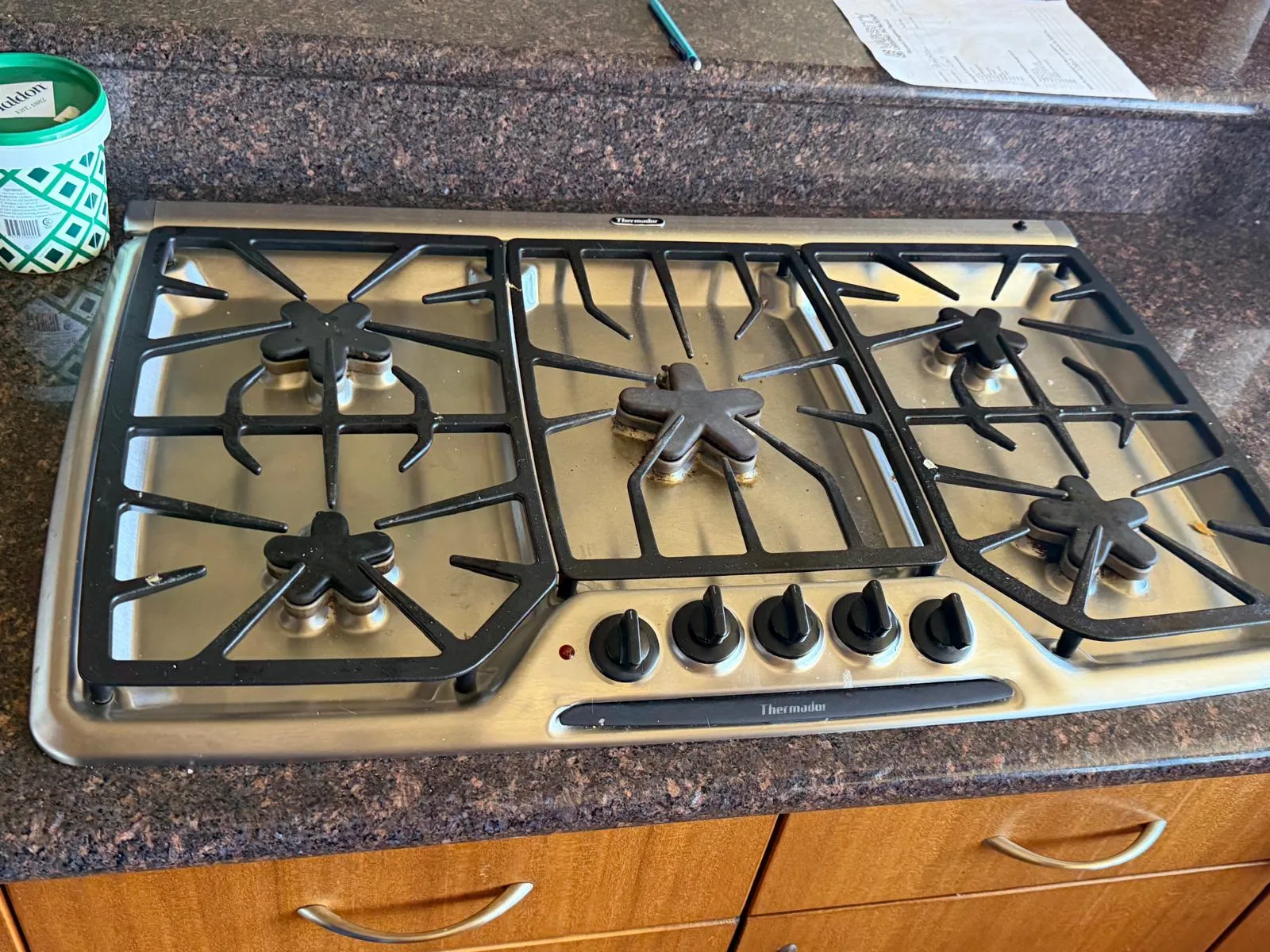
The ceramic-tipped electrode sits low in the burner base, right where water pools after a cleaning session or where a boil-over lands during cooking. A wet or dirty electrode either can't spark at all, or sparks too weakly to light the burner, so the control keeps calling for ignition and you get continuous clicking instead of a flame. Thermador's pedestal-style Star burner design traps moisture more easily around the base than a flat sealed burner does, which is why this is the single most common igniter complaint we see.
Symptoms: Clicking that won't stop; a burner that won't light right after you've cleaned the cooktop or after a spill; the burner lights fine once everything is bone dry.
DIY fix: Turn the cooktop off and let it cool. Remove the cap and lift the burner base, then dry the electrode, the cap, and the base thoroughly with a lint-free cloth. Let the burner air-dry another 30 to 60 minutes, especially around the ceramic electrode housing, before testing again.
Repair cost: Usually resolved by drying, no parts needed. Estimates vary by brand, part availability, and diagnosis. Final quote is provided before repair.
Misaligned or Dirty Burner Cap
Each burner cap has to sit dead-center and flush on its base for the spark to jump the gap correctly. Caps get bumped out of position, or swapped onto the wrong size burner, almost every time someone lifts them off to clean the cooktop. A cap that's even slightly off-center, or one with a film of grease on the underside, blocks the spark from reaching the ports the way it should.
Symptoms: One specific burner clicks without lighting, or lights only intermittently, while its neighbors work fine; the trouble usually starts right after a deep clean.
DIY fix: With the cooktop off and cool, lift the cap, wipe the underside clean, and reseat it centered and flush on the base. Double-check that each cap size matches its burner; a small simmer-burner cap accidentally placed on a larger burner is a common mix-up after cleaning.
Repair cost: Usually free once reseated; a warped or cracked cap runs about $40 to $90 to replace. Estimates vary by brand, part availability, and diagnosis. Final quote is provided before repair.
Clogged Burner Ports
The small ports ringing each burner are where gas actually meets the spark. Grease and food debris narrow or block those ports over time, and a bad boil-over can plug several at once. Blocked ports don't just weaken the flame; if they're clogged badly enough, the burner won't light even when you hold an open match directly to it, which is what separates this cause from a pure ignition problem.
Symptoms: Weak, uneven, or yellow-tipped flames on burners that do light; a burner that fails even the match test; visible residue in or around the ports.
DIY fix: With the cooktop off and cool, clear each port with a straight sewing pin or a fine wire burner-cleaning tool, poking straight in and out. Never use a wooden toothpick, since the tip can snap off and lodge inside the port, and never use a drill bit or anything that widens the hole; an enlarged port changes the flame pattern and can create a burn hazard.
Repair cost: Usually free once cleared; a damaged burner ring or grate runs about $50 to $120 to replace. Estimates vary by brand, part availability, and diagnosis. Final quote is provided before repair.
Worn or Cracked Spark Electrode
Every burner has its own ceramic-tipped electrode, wired individually back to a shared spark module. Heat cycling over years of use eventually cracks the ceramic insulation or erodes the electrode tip. Once that happens, the spark can leak to a nearby ground point instead of jumping cleanly to the burner ring, so that one burner gets a weak spark, or none at all, while every other burner on the same cooktop keeps working normally.
Symptoms: One specific burner never sparks, or sparks weakly with the arc visible somewhere other than at the burner ring; that same burner lights immediately with the match test, confirming gas flow isn't the problem.
Confirmation: Inspect the ceramic tip under good light for a hairline crack or chip, and confirm the wire connector is fully seated at both ends. A cracked or chipped electrode can't be repaired, only replaced, and the replacement has to match your specific model.
Repair cost: $150 to $350. Estimates vary by brand, part availability, and diagnosis. Final quote is provided before repair.
Failed Spark Module or Wet/Stuck Spark Switch
One spark module handles ignition for every burner on the cooktop, and a micro-switch behind each control knob tells the module which burner to fire. If the module's circuitry fails, or a switch gets stuck closed, often from a spill working its way under the control panel, or shorts out from moisture, the module can send continuous sparks to one or all burners even with every knob turned off.
Symptoms: Every burner clicks nonstop with all knobs off and the cooktop fully dry; the clicking never resolves on its own; the problem often starts right after liquid gets into the control panel area.
This is where DIY stops. The module and switches sit behind the control panel and carry line voltage, so testing and replacement belong to a technician. Our Thermador appliance repair team in Orange County diagnoses electrode, cap, and module faults in one visit, so a perfectly good electrode never gets swapped while a module problem goes unfixed.
Repair cost: Spark module $250 to $500; spark switch $180 to $400. Estimates vary by brand, part availability, and diagnosis. Final quote is provided before repair.
DIY Checks and Cleaning
Work through these steps in order before you call for service. Most Thermador igniter clicking problems get fixed, or at least clearly diagnosed, right here.
- Turn off and let cool. Never work on a burner that's still warm or while gas is actively flowing.
- Dry everything first. This single step resolves more "won't stop clicking" calls than anything else on this list.
- Clean the electrode and cap. Use a soft toothbrush and warm soapy water; never a wire brush, which scratches the ceramic and creates new grooves for debris to hide in.
- Clear clogged ports carefully. A straight sewing pin or fine wire works well; never a wooden toothpick, since the tip can snap off inside the port, and never a drill bit or anything that widens the hole.
- Dry again and reseat the caps. Make sure each cap sits centered and flush on its matching burner base.
- Test for a steady blue flame. A lazy yellow or orange-tipped flame means the ports still aren't fully clear.
- Know when to stop. One burner that still won't spark after a full cleaning and drying usually needs a new electrode. Every burner clicking nonstop after a dry, knobs-off test points to the module or a switch, and that's a job for a technician.
Pro Repair Scope
A few of these fixes are well within reach for a confident homeowner; others are not. Drying out a wet electrode, cleaning a cap, and clearing a clogged port with a pin are all safe, tool-free tasks anyone can do with the cooktop off and cool.
Replacing the electrode itself is more involved. It usually means removing the burner base, disconnecting an individual wire lead, and installing the correct electrode for that specific burner size, since Thermador electrodes are not interchangeable across burner positions.
The spark module and the switches behind the control knobs are not a DIY repair. They sit behind the control panel, carry line voltage, and a failure here can look identical to a bad electrode from the outside (clicking without lighting), which is why a technician tests the module and switches directly rather than guessing from symptoms alone.
Repair Costs in Orange County
Estimates vary by brand, part availability, and diagnosis. Final quote is provided before repair.
| Repair / Component | Typical Cost Range | When It Applies |
|---|---|---|
| Service call / diagnostic: Orange County market average (generally credited toward repair if you proceed) | $95 – $150 | All models |
| Single igniter / spark electrode replacement | $150 – $350 | One burner won't spark |
| Spark module replacement | $250 – $500 | All burners click nonstop |
| Spark switch replacement | $180 – $400 | All burners click nonstop |
Our own company diagnostic fee is a flat $99, applied toward the repair if you proceed.
A new Thermador gas cooktop typically runs $1,850 to $2,600, and the ExtraLow Select models common in Newport Beach and Laguna Niguel kitchens run $2,800 to $3,200 or more. Thermador cooktops routinely last 10 to 15 years or longer with reasonable care, so even a spark module replacement, a few hundred dollars, is a small fraction of buying new. For a cooktop that's otherwise in good shape, repairing the ignition system is almost always the more rational choice.
Frequently Asked Questions
Why do all my Thermador burners keep clicking?
First rule out ExtraLow: on Thermador Star burners, that feature pulses the flame off and re-sparks about every 60 seconds to hold a low simmer, and that clicking is completely normal. If ExtraLow is not in use, every knob is off, and the cooktop is fully dry, but the clicking continues anyway, the shared spark module has likely failed, or a switch behind one of the control knobs is stuck closed or shorting from moisture. Dry the cooktop and control panel first. If clicking persists after drying, treat it as an electrical repair and call a technician, since the module and switches carry line voltage.
Why will one burner light with a match but not with the igniter?
That is actually good diagnostic news. If a burner lights when you hold a match to it, gas is flowing to that burner just fine, so the fault sits entirely in the ignition system, not the gas supply. On a single burner, that usually means a wet or dirty electrode, a burner cap that is not seated centered on its base, or debris blocking the spark gap. Dry and reseat the cap first. If that one burner still will not spark while its neighbors light normally, the ceramic electrode has likely cracked or worn out and needs replacing.
Is it safe to keep using a Thermador burner that clicks?
A brief click at startup followed by a steady blue flame is completely normal, and so is the periodic re-spark click you hear on an ExtraLow burner every 60 seconds or so. What is not normal, and not safe to ignore, is a burner that clicks continuously without ever lighting while gas keeps flowing. If that happens, turn the knob off, wait a minute for any gas to clear, and troubleshoot before trying again. Never leave a clicking, unlit burner running unattended.
I cleaned my cooktop and now it won't stop clicking. What happened?
This is almost always moisture, not a broken part. Water or cleaning solution around the ceramic electrode, or trapped under a burner cap, stops the spark from jumping the gap the way it should and the control just keeps calling for ignition. Turn the cooktop off, dry the caps, bases, and electrodes thoroughly, and let everything air-dry another 30 to 60 minutes before testing again. While you are in there, confirm each cap is reseated dead-center and flush on its matching burner base, since a cleaning session is also the most common time for caps to end up misaligned.
How much does a Thermador cooktop igniter repair cost in Orange County?
Our own company diagnostic fee is a flat $99, applied toward the repair if you proceed. Beyond that, costs depend on what's actually failed: a single igniter or spark electrode typically runs $150 to $350, a spark module runs $250 to $500, and a spark switch runs $180 to $400, all figures including parts and labor. Estimates vary by brand, part availability, and diagnosis. Final quote is provided before repair.