How a Wolf Oven Lights
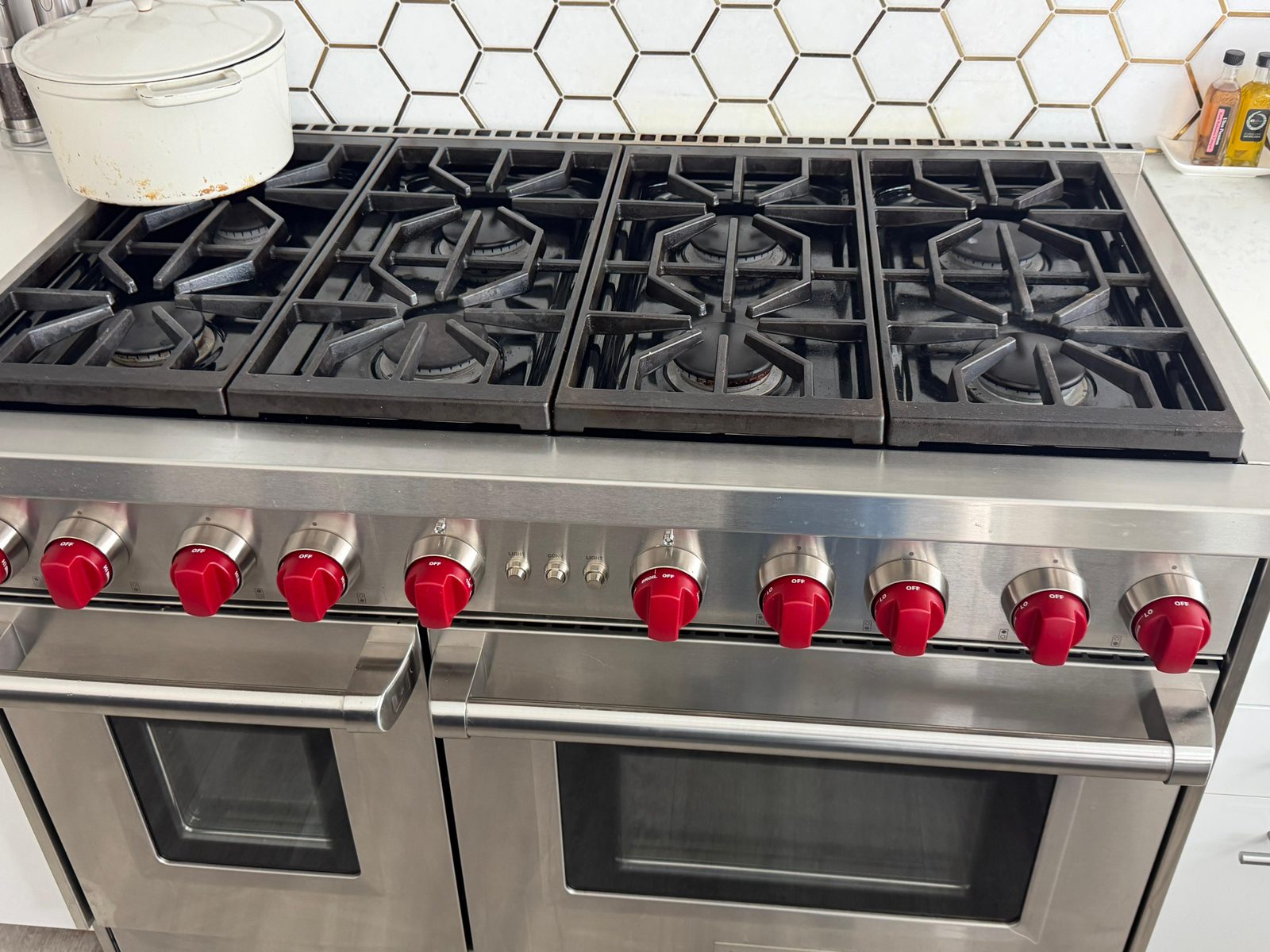
Wolf builds two kinds of range: all-gas models, where the oven is heated by a gas bake burner, and dual-fuel models, which pair a gas cooktop with an electric oven. The two heat completely differently, and knowing which one you own points you straight at the likely fault.
On an all-gas Wolf oven, a glow-bar igniter (a hot-surface igniter) sits next to the bake burner. When you set a temperature, the igniter heats up and the safety gas valve waits until the igniter is drawing enough current to prove it is hot enough to light the gas. Only then does the valve open. This current-sensing design is a safety feature: it means gas will not flow until there is a guaranteed ignition source. It is also why a weak igniter stops the oven even while it still glows.
On a dual-fuel Wolf oven, there is no igniter at all in the oven. An electric bake element does the heating, a temperature sensor (an RTD probe) tells the control board the cavity temperature, and a relay on the board switches power to the element. A cold dual-fuel oven is always an electrical fault, never a gas one.
For Wolf oven and range repair in Orange County, Universal Appliances Repair handles both platforms and carries the common igniter, element, and sensor parts for same-day completion on most visits.
The 5 Causes: Diagnosis by Symptom
Weak or Failed Bake Igniter (Gas Ovens)
Symptom: the oven stays cold, the cooktop works normally, and if you look through the bottom of the cavity you see the igniter glowing dull orange but no flame.
This is the number-one Wolf oven no-heat cause. The glow-bar igniter weakens with age and eventually cannot draw enough current to trip the safety gas valve open. A telltale sign is a longer and longer preheat over several weeks, then no ignition at all. Because the igniter still lights up, homeowners often rule it out, but glowing is not the same as working.
Fix: the igniter must be replaced, and it should be matched to the specific Wolf model. This is a technician job: it involves accessing the burner, disconnecting the gas-safe wiring, and confirming the new igniter reaches full current draw before signing off.
Repair cost: $250–$450. Estimates vary by brand, part availability, and diagnosis. Final quote is provided before repair.
Failed Safety Gas Valve (Gas Ovens)
Symptom: the igniter glows bright orange-white (clearly healthy) for well over 90 seconds, but the gas still never lights.
If the igniter is drawing full current and glowing brightly but no gas arrives, the safety gas valve itself has failed and is not opening. This is less common than a weak igniter, which is exactly why it should be diagnosed carefully: replacing the valve when the igniter is the real problem is a costly mistake, and the reverse is equally true. A technician measures the igniter current draw to tell the two apart before replacing either part.
Repair cost: $300–$550. Estimates vary by brand, part availability, and diagnosis. Final quote is provided before repair.
Broken Bake Element (Dual-Fuel Ovens)
Symptom: on a dual-fuel model, the oven stays cold and you may see a visible break, blister, or scorch mark on the element at the bottom of the cavity.
The electric bake element is a resistance heater, and it fails the same way a light bulb does: eventually the metal fatigues and the circuit breaks. Sometimes the failure is visible as a separation or a burned spot; sometimes it looks fine but has lost continuity internally. The broiler element at the top may still work, which can make the oven seem partly alive while bake stays cold.
Fix: the element is replaced. A technician confirms the failure with a continuity test rather than by sight alone, since an intact-looking element can still be open internally.
Repair cost: $250–$450. Estimates vary by brand, part availability, and diagnosis. Final quote is provided before repair.
Faulty Temperature Sensor
Symptom: the oven heats but never reaches temperature, shuts off early, or reads wildly wrong, and on some models an error appears on the display.
The temperature sensor (RTD probe) tells the control board how hot the cavity is. When it drifts or fails, the board gets bad data: it may think the oven is already hot and never call for heat, or cut the element or burner off far too early. This shows up as an oven that will not hold temperature rather than one that is stone cold, though a shorted sensor can prevent heating entirely.
Fix: the sensor is tested for correct resistance at room temperature and replaced if it is out of spec. It is a straightforward part on both gas and dual-fuel Wolf ovens.
Repair cost: $200–$400. Estimates vary by brand, part availability, and diagnosis. Final quote is provided before repair.
Control or Relay Board Fault
Symptom: the oven will not respond, will not hold a setting, or the display behaves erratically, and the igniter or element never receives power.
The control board (and, on some models, a separate relay board) switches power to the igniter circuit or the bake element. When a relay fails or the board loses a function, the heating side never energizes even though everything downstream is fine. Board faults can also follow a power surge, which is worth mentioning to the technician if you have had one recently.
Because the board is the most expensive part in this guide, it should be the last suspect, confirmed only after the igniter, valve, element, and sensor have been ruled out. A good technician does not condemn the board first.
Repair cost: $400–$900. Estimates vary by brand, part availability, and diagnosis. Final quote is provided before repair.
What You Can Safely Check Yourself
Before calling a technician, work through this short list. Each step is safe for a homeowner and helps narrow the diagnosis, which can shorten the service visit.
- Confirm the oven, not the cooktop, is the problem. If the burners light but the oven stays cold, you have an oven-side fault, which rules out the shared gas supply and points at the igniter, valve, element, sensor, or board.
- Check the circuit breaker. Even a gas Wolf oven needs 120V power for the igniter and controls. A dual-fuel oven needs a 240V circuit for the element. A tripped breaker leaves a cold oven with a live cooktop. Reset it and retest.
- Watch the igniter on a gas model. With the oven set to bake, look through the bottom of the cavity (remove the oven floor panel if your model has one). A bright orange-white glow that lights the gas is healthy; a dull red glow that never lights points to a weak igniter.
- Look for a visible break on a dual-fuel element. A separation, blister, or burn mark on the bake element confirms it has failed. No visible damage does not clear it, but visible damage confirms it.
- Note any recent power surge. If the oven quit right after an outage or a surge, mention it. That history points toward the control board and saves diagnostic time.
If the self-checks confirm the oven side is at fault, the repair requires accessing the burner, element, or control assembly with the correct OEM Wolf parts. A Wolf-experienced technician in Yorba Linda, Anaheim, Irvine, or elsewhere in Orange County will carry the common igniters and sensors on the van for same-day completion in most cases.
Repair Costs in Orange County
Estimates vary by brand, part availability, and diagnosis. Final quote is provided before repair.
| Repair | Typical Cost Range | Applies to |
|---|---|---|
| Service call / diagnostic: Orange County market average (generally credited toward repair if you proceed) | $95 – $150 | All Wolf ovens |
| Bake igniter replacement | $250 – $450 | Gas ovens |
| Safety gas valve replacement | $300 – $550 | Gas ovens |
| Bake element replacement | $250 – $450 | Dual-fuel ovens |
| Temperature sensor (RTD) replacement | $200 – $400 | Gas and dual-fuel |
| Control / relay board replacement | $400 – $900 | Gas and dual-fuel |
Our company fee is $99 flat for the diagnostic visit, credited toward the repair if you proceed. Wolf oven repairs sit above standard-range prices for the same reasons the whole platform does: OEM parts built to tighter tolerances and a build that takes more care to service without marking the finish. Both are legitimate, and both are worth it on a range built to last decades.
For context, a new Wolf range starts around $4,500 for an entry-level model and climbs past $12,000 for a flagship dual-fuel. A bake igniter or element repair at the ranges above is a small fraction of replacement on any Wolf currently sold, so unless the oven has multiple simultaneous failures, repair is clearly the right economic call. Our oven and stove repair service in Orange County covers Wolf alongside Viking, Thermador, and every major residential brand.
Wolf Oven Repair Across Orange County
Universal Appliances Repair services Wolf gas and dual-fuel ranges in Yorba Linda, Anaheim, Irvine, and throughout Orange County. OEM igniters, elements, and sensors stocked for same-day diagnosis on most no-heat calls. See our full Wolf service page for what we cover.
Book a Repair VisitFrequently Asked Questions
Why is my Wolf oven not heating but the cooktop works?
On a gas Wolf range, the cooktop and the oven use completely separate ignition systems, so one can fail while the other works normally. The cooktop uses spark igniters at each burner; the oven uses a glow-bar bake igniter that has to heat up and draw enough current to open the safety gas valve. When that igniter weakens with age, it still glows but no longer pulls enough current to release the gas, so the oven never lights while the cooktop is unaffected. A weak bake igniter is the single most common reason a Wolf oven stops heating.
How do I know if my Wolf oven bake igniter is bad?
Turn the oven to bake and watch the igniter through the bottom of the cavity, usually after removing the oven floor panel. A healthy igniter glows bright orange-white and the gas lights within about 90 seconds. A failing igniter glows dull orange or red and the gas never ignites, or takes several minutes. If it glows but the oven does not light, the igniter is weak and needs replacement even though it still lights up. Glowing is not the same as working; the current draw is what opens the gas valve.
Is it safe to use a Wolf oven that is not heating?
If the oven is not lighting at all, stop using it and turn it off. A weak igniter that is drawing power but failing to open the valve promptly can allow unburned gas to collect before it finally ignites, which produces a delayed flare when it does catch. That is a real safety concern with gas ovens. Turn the oven off, leave the door open to let any gas clear, and schedule service rather than repeatedly trying to light it.
How much does it cost to fix a Wolf oven that is not heating in Orange County?
Our diagnostic fee is $99 flat, applied toward the repair if you proceed. A bake igniter replacement, the most common Wolf oven no-heat repair, runs $250 to $450 in Orange County. A safety gas valve is $300 to $550, a bake element on a dual-fuel model is $250 to $450, a temperature sensor is $200 to $400, and a control or relay board is $400 to $900. Estimates vary by brand, part availability, and diagnosis. Final quote is provided before repair.
Why does my Wolf dual fuel oven not heat when the gas burners work?
A Wolf dual fuel range pairs gas cooktop burners with an electric oven, so the two run on entirely different systems. When the gas burners work but the electric oven stays cold, the problem is on the electric side: most often a burned-out bake element, a failed temperature sensor that is misreading the cavity, or a control board relay that is not switching power to the element. A technician can test the element and sensor for continuity to identify which one has failed.