Built-In vs Freestanding: Why Airflow Matters
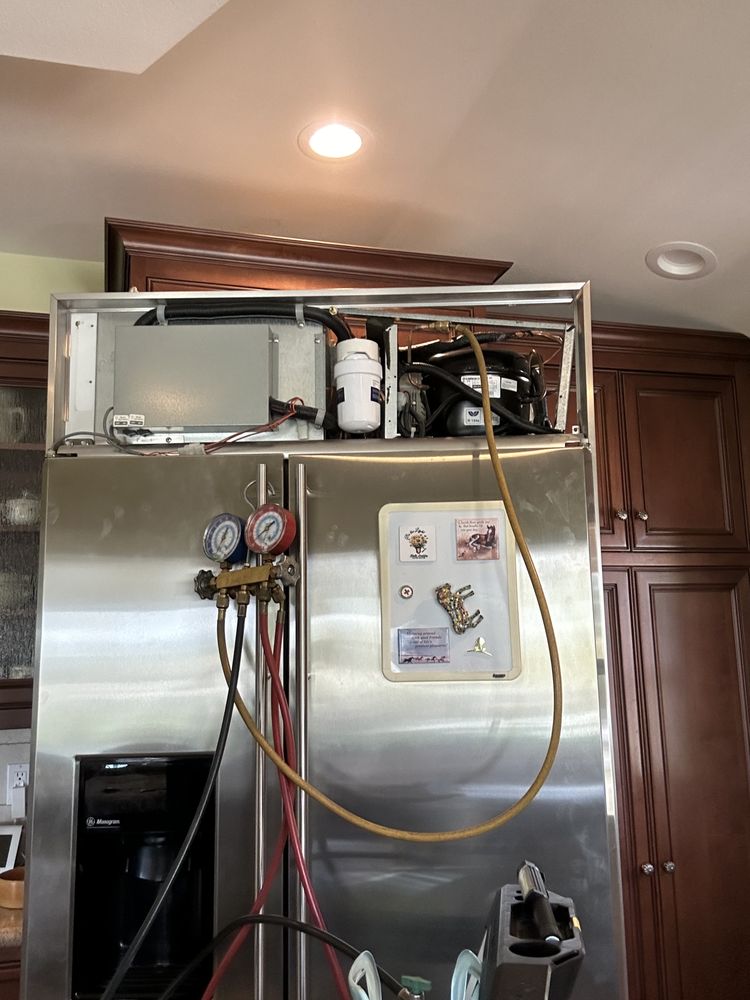
On a freestanding Viking refrigerator, the condenser coils sit out in the open at the back of the cabinet, where room air can flow across them freely and a quick vacuum pass once or twice a year is about all the maintenance they need. Built-in Viking columns and side-by-sides, the VCSB, VCBB, DDBB, and VCFF families, are a different animal. Because the cabinetry seals the unit into a fitted opening, the condenser coils get relocated behind a lower kick-plate grille, or on some column configurations they sit on top of the cabinet near the compressor, and a dedicated fan has to pull air in and push it back out through a narrow gap.
That tight enclosure works fine when it's clean, but it also means dust and pet hair have nowhere else to go, so built-ins pack a coil-clogging layer faster than a freestanding unit ever would. Once the coils can't shed heat, the compressor runs longer and hotter trying to compensate, and the whole cabinet drifts warm even though every fan and relay underneath is working correctly. This is exactly why Viking's own service guidance calls for cleaning the condenser coils at least twice a year, more often in homes with pets, and why coil-related failures show up disproportionately in built-in installations across Newport Beach, Irvine, and Laguna Niguel kitchens. For the full picture of what we cover on Viking's refrigeration lineup, see our Viking appliance repair team in Orange County.
Causes Ranked by Likelihood
Dirty or Dust-Clogged Condenser Coils
The condenser coils reject the heat the refrigerant absorbs from inside the cabinet. When a layer of dust blankets the fins, that heat has nowhere to go, so the compressor runs longer, runs hotter, and still can't pull the cabinet down to temperature. This is the single most common reason we get called out to a Viking that "just isn't as cold as it used to be," and it disproportionately affects built-in columns and side-by-sides where the coils are boxed in behind a grille with tight airflow.
Symptoms: both the refrigerator and freezer trend warm together; the compressor runs almost continuously; the lower grille or the top of the cabinet feels noticeably hot; cooling worsens gradually over weeks rather than failing all at once.
Confirmation test: unplug the unit, remove the lower grille or access panel (check your model's manual for the exact location), and look at the coils directly. A visible gray felt of dust confirms the cause, and the fix is a thorough vacuum and coil brush, not a parts order.
Repair cost: a DIY fix in most cases, or a quick task folded into a standard service visit if a technician handles it. Estimates vary by brand, part availability, and diagnosis. Final quote is provided before repair.
Evaporator Fan Motor Failure
Most Vikings use a single evaporator coil tucked behind a panel in the freezer, and the evaporator fan blows air across that coil, pushing cold air up through a duct into the fresh-food section above. When that fan motor seizes or burns out, the freezer keeps making ice because it sits directly on top of the cold coil, but the refrigerator section stops receiving any cold air at all and slowly climbs toward room temperature. This "freezer fine, fridge warm" pattern is the clearest tell for a dead evaporator fan.
Symptoms: freezer stays cold and keeps making ice; the refrigerator compartment warms over a day or two; you may hear the fan rattling or grinding before it fails outright, or hear nothing once it has fully seized.
Confirmation test: unplug the refrigerator, remove the rear panel inside the freezer compartment, and try to spin the fan blade by hand. A blade that won't turn, or turns with heavy resistance, confirms a seized motor. If the blade spins freely but is caked in a thick layer of ice, the fan isn't the problem, the defrost system is (see cause #4 below).
Repair cost: $200 – $400. Estimates vary by brand, part availability, and diagnosis. Final quote is provided before repair.
Condenser Fan Motor Failure
The condenser fan pulls room air across the condenser coils and over the compressor itself, carrying rejected heat away from the unit. On built-in Vikings this fan is doing double duty, since it's also fighting the tighter airflow of the cabinet enclosure. When it stalls, the compressor has no way to cool itself, so the entire box warms and the compressor compartment can get uncomfortably hot to the touch, sometimes accompanied by a buzzing or humming sound as the motor struggles to start.
Symptoms: the whole refrigerator and freezer warm together; the compressor area feels noticeably hot; a buzzing or clicking sound near the compressor compartment with no accompanying breeze from the fan.
Confirmation test: with the unit unplugged, locate the condenser fan, typically mounted near the compressor behind the lower grille, and spin the blade by hand. Resistance or a blade that won't turn confirms the motor has failed.
Repair cost: $200 – $400. Estimates vary by brand, part availability, and diagnosis. Final quote is provided before repair.
Faulty Defrost System (Heater, Thermostat, or Timer)
Every frost-free Viking refrigerator runs periodic defrost cycles to melt the thin layer of frost that naturally forms on the evaporator coil. When the defrost heater, defrost thermostat, or the control that times the cycle fails, frost keeps building instead of melting, and it eventually thickens into a solid sheet of ice that blocks airflow across the coil entirely. Because that blocked airflow stops cold air from reaching the fresh-food section, a defrost failure can look exactly like a dead evaporator fan from the outside, warm fridge, cold freezer, but the giveaway is visible ice.
Symptoms: the same warm-fridge, cold-freezer pattern as a fan failure, but you'll find visible frost or a solid sheet of ice on the rear panel inside the freezer once you look; cooling may briefly improve after a manual defrost and then decline again over days as ice rebuilds.
Confirmation test: unplug the unit for 24 to 48 hours to let the ice melt completely (put towels down to catch the water), then plug it back in. If cooling returns and holds steady for several days before slowly declining again, that strongly points to a failed defrost heater, thermostat, or timer rather than the fan.
Repair cost: $100 – $250. Estimates vary by brand, part availability, and diagnosis. Final quote is provided before repair.
Start Relay, Control Board, or Compressor Failure
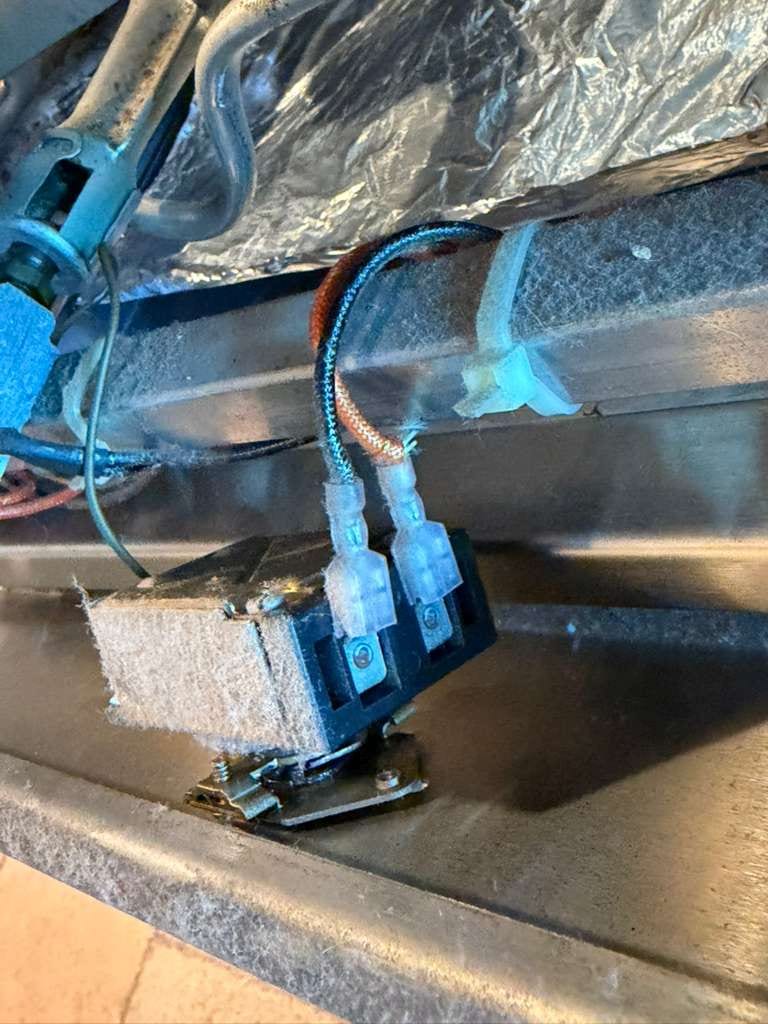
The start relay is a small component that feeds the compressor the extra jolt of current it needs to get spinning. When the relay fails, the compressor never starts, which means no cooling anywhere in the cabinet, fridge or freezer. It's one of the more common failures we see because it's a wear part, and it's also one of the cheaper fixes, so it's worth ruling out before assuming the worst. A bad control board or thermistor can cause a similar no-cooling symptom simply by never sending the call for cooling, even though every mechanical part underneath is fine. The genuine worst case is a failed compressor itself, a sealed-system repair and the most expensive failure on this list.
Symptoms: no cooling at all in either compartment; a clicking or buzzing sound near the compressor every few minutes as it repeatedly tries and fails to start; in some cases, total silence with no attempt to start whatsoever.
Confirmation test: listen at the compressor compartment. Repeated clicking every few minutes without the compressor ever catching and running is the classic start-relay symptom, and a relay that rattles when gently shaken (unplugged and removed) is usually confirmed bad. No clicking and no hum at all means the fault could be the relay, the board, or the compressor windings themselves, and that requires a multimeter test to isolate.
Repair cost: start relay $50 – $200; control board $400 – $650; compressor or sealed system $1,200 – $1,800, the most expensive repair on this list and the one place where sealed-system regulations require a licensed technician. Estimates vary by brand, part availability, and diagnosis. Final quote is provided before repair.
DIY Checks You Can Do Today
Before scheduling a service visit, run through these checks. Several Viking cooling problems can be identified, and a few resolved, without tools.
- Verify the temperature settings. Confirm the refrigerator is set to about 37 degrees Fahrenheit and the freezer to about 0 degrees, and that no demo or vacation mode is active. After any setting change, give the unit a full 24 hours before judging the result.
- Check for blocked airflow inside the cabinet. Overpacked shelves or items pressed against the rear vents can starve internal air circulation even when every mechanical part is healthy. Leave a gap around the rear vents on every shelf.
- Clean the condenser coils. This is the single highest-yield DIY fix. Locate the coils behind the lower grille or on top of the cabinet per your owner's manual, unplug the unit, vacuum thoroughly, and use a coil brush between the fins without bending them. Allow up to 24 hours for the cabinet to recover.
- Dollar-bill test the door gaskets. Close the door on a dollar bill at several points around the seal and pull gently. If it slides out with little resistance, the gasket is no longer sealing properly and warm air is leaking in.
- Listen for compressor behavior. A steady hum is normal; repeated clicking every few minutes without the compressor catching points to a start relay problem.
- Don't overload the cabinet or load it with hot food. Both restrict airflow and make the compressor work harder than necessary.
- Always unplug before removing a panel or grille, and leave any refrigerant or sealed-system work to a licensed technician.
Pro Repair Scope
A few Viking cooling repairs are reasonable for a confident homeowner; most are not. Here is how the work breaks down.
Condenser coil cleaning: genuinely a DIY task on both freestanding and built-in models. The only real challenge on a built-in is locating and removing the correct access panel, which your owner's manual will show.
Evaporator fan and condenser fan motor replacement: possible for a comfortable DIYer, but both require partial disassembly of the freezer compartment or the compressor area, and the correct OEM part number matters since Viking fan motors are not universal across model families.
Defrost system components: more involved, since the defrost heater and thermostat sit behind the evaporator cover deep in the freezer and require careful reassembly to avoid a repeat ice buildup.
Start relay, control board, and compressor: these call for professional diagnosis. A start relay is a simple swap for a technician but easy to misdiagnose without an ammeter, and any compressor or sealed-system work involves refrigerant handling that is legally restricted to certified technicians under EPA Section 608. Our team services Viking refrigerators, columns, and side-by-sides across Orange County. For the full picture of what we cover on refrigeration equipment, see our refrigerator repair page for Orange County.
Repair Costs in Orange County
Estimates vary by brand, part availability, and diagnosis. Final quote is provided before repair.
| Repair / Component | Typical Cost Range | When It Applies |
|---|---|---|
| Service call / diagnostic: Orange County market average (generally credited toward repair if you proceed) | $95 – $150 | All models |
| Evaporator fan motor | $200 – $400 | Freezer stays cold, fridge warms |
| Condenser fan motor | $200 – $400 | Whole unit warm, compressor hot |
| Defrost heater / thermostat | $100 – $250 | Visible ice on evaporator |
| Start relay | $50 – $200 | Clicking, compressor won't start |
| Compressor / sealed system | $1,200 – $1,800 | No cooling, no clicking or hum |
| Control board | $400 – $650 | No call for cooling at all |
Our own company diagnostic fee is a flat $99, applied toward the repair if you proceed.
A new 42-inch Viking built-in refrigerator lists around $11,900, and full column or side-by-side configurations commonly run $8,000 to $13,000 or more, designed for 15 to 20 years of service. Against those numbers, even a full compressor and sealed-system job is a small fraction of replacement cost. For a Viking refrigerator under about 15 years old and otherwise in good shape, repair is almost always the right economic call, and swapping out a built-in also means cabinetry rework to fit a new unit into the same opening.
Frequently Asked Questions
Why is my Viking refrigerator not cooling but the freezer still works?
This is almost always an airflow problem, not the compressor. The most common cause is a failed evaporator fan motor that no longer pushes cold freezer air up into the fresh-food section, so the freezer stays cold on its own while the refrigerator above it slowly warms. The second most common cause is a failing defrost system that lets frost build up on the evaporator coil and physically blocks that same airflow. To tell them apart, unplug the unit and check the rear panel inside the freezer: an iced-over fan blade points to a defrost problem, while a clear blade that will not spin points to a dead fan motor. A stuck air damper between the compartments can cause the same symptom on some models.
How do I clean the condenser coils on a Viking refrigerator?
On built-in Viking columns and side-by-sides, the condenser coils usually sit behind the lower kick-plate grille, though some column configurations put them on top of the cabinet near the compressor, so check your owner's manual for the exact location. Unplug the refrigerator first, remove the grille or access panel, and vacuum the coils thoroughly, then run a coil brush between the fins to loosen packed-in dust. Be careful not to bend the fins while you work. Reassemble the panel and give the unit up to 24 hours to fully recover its temperature. Viking recommends cleaning the coils at least twice a year, and more often in homes with pets or heavy dust.
How much does it cost to fix a Viking refrigerator that isn't cooling?
Our diagnostic fee is a flat $99, applied toward the repair if you proceed. Because Viking is a premium built-in brand, its parts run higher than mainstream residential brands. As rough ranges including parts and labor: an evaporator fan motor runs about $200 to $400; a condenser fan motor about $200 to $400; a defrost heater or thermostat about $100 to $250; a start relay about $50 to $200; a control board about $400 to $650; and a full compressor or sealed-system repair about $1,200 to $1,800. Estimates vary by brand, part availability, and diagnosis. Final quote is provided before repair.
How long should it take for my Viking to cool back down after a fix or reset?
Give it about 30 minutes for airflow to fully resume after a repair or coil cleaning, and a full 24 hours for the entire cabinet to stabilize back at temperature. A soft reset can clear a control glitch on its own: unplug the unit for 60 seconds, or on models that support it, hold the temperature buttons for about 5 seconds. If the refrigerator is still warm after 24 hours, or you hear repeated clicking near the compressor with no start, that points to a real component failure and it is time to call a technician.
My Viking is 12 to 15 years old and needs a repair. Is it worth fixing or should I replace it?
A repair can be practical when the rest of a built-in refrigerator is in good condition. Use the 50% rule as a rule of thumb: compare the written repair estimate with a current replacement-and-installation quote for a comparable model. Cabinet fit, structural condition, age, and repeat failures can change the decision.